
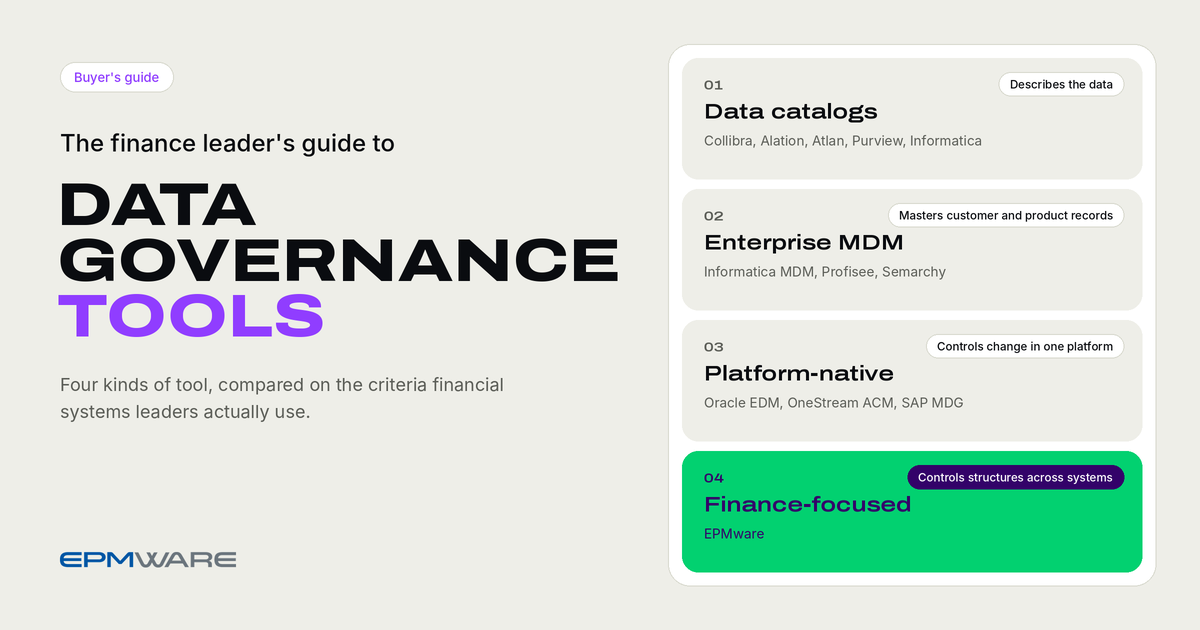
Ask an AI assistant for the best data governance tools and you will get a confident list: Collibra, Alation, Atlan, Informatica, Microsoft Purview. Add the words "for financial systems" and the list barely changes. Most of the guides behind those answers were written for a bank's chief data office, with BCBS 239, lineage, and data privacy in mind. They are good guides to that problem. They are not guides to yours.
A financial systems leader governs something more specific: the chart of accounts, the legal entities, the cost centers, the hierarchies, and the mappings that turn ledger balances into reported results across the ERP, the EPM applications, and the data warehouse. When one of those structures changes, a number changes, and an auditor wants to know who approved it. Some tools on the standard list help with that. Many were never meant to.
This guide sorts the market into four kinds of tool, compares them on finance criteria, and says where each one is the right choice. One disclosure before we start: EPMware is our product, and it appears in the fourth category. We have tried to be fair to every vendor here, including naming the situations where a catalog or an enterprise platform is the better answer.
Two different jobs are both called data governance
The phrase covers two jobs that share a name and very little else.
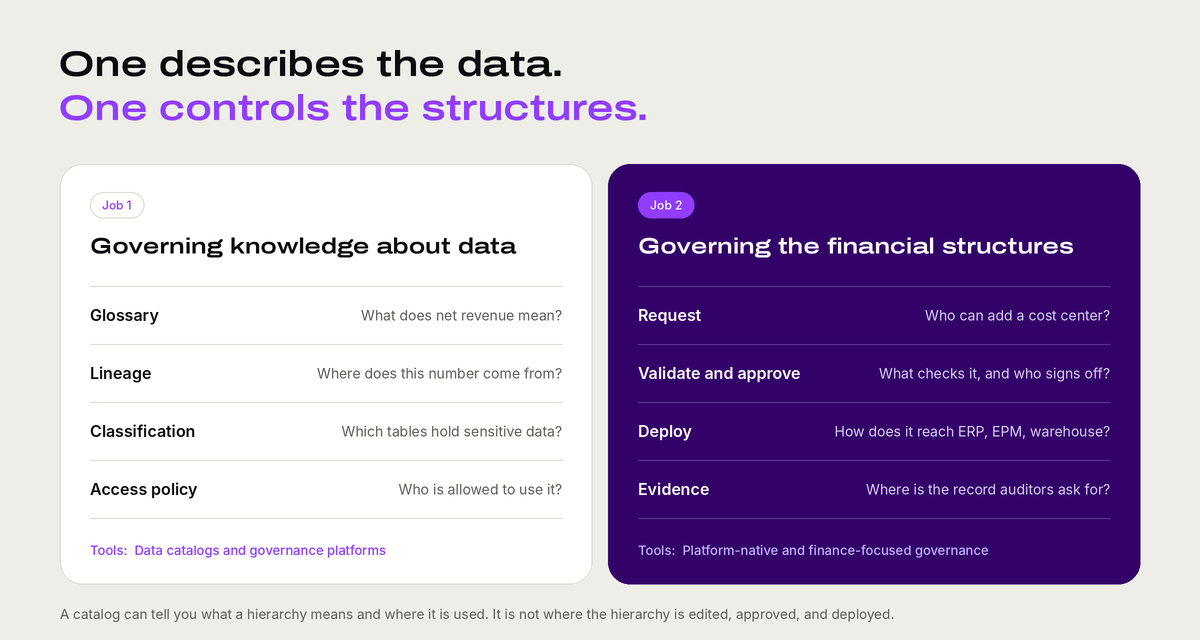
Catalogs describe the data. Change control over financial structures is a different job.
The first job is governing knowledge about data. What does "net revenue" mean, and which definition is the approved one? Where does this dashboard number come from? Which tables hold personal data, and who is allowed to see them? This is the work of data catalogs and governance platforms: a business glossary, lineage, classification, data quality scores, and access policy, across every system in the enterprise.
The second job is governing the financial structures themselves. Who can add a cost center, move an entity under a different parent, or change which accounts roll into revenue? Who approves it, what validates it, how does it reach the ERP, the consolidation system, the planning application, and the warehouse, and where is the evidence? This is change control over master data, and it is the job that SOX testing, the close calendar, and the consolidation depend on.
The two jobs fit together. A catalog can tell you what an account hierarchy means and where it is used. It is not where the hierarchy is edited, approved, and deployed. Most disappointing evaluations start with a team buying a tool for one job and expecting it to do the other.
What financial systems leaders should evaluate
Seven criteria separate the tools. The first six belong to the second job. The seventh belongs to the first, and it is here because a fair comparison has to score what catalogs are actually built for.
- Structure and hierarchy management: Can the tool hold accounts, entities, cost centers, alternate hierarchies, and mappings as first-class objects, with the properties each target system needs?
- Change workflow and separation of duties: Is every change requested, reviewed, and approved through a configurable path, with the requester, approver, and deployer kept apart?
- Validation before deployment: Are duplicates, invalid properties, and members that would break a consolidation or a load blocked before approval, against the rules of each target?
- Deployment to ERP, EPM, and the warehouse: Does an approved change reach every system that depends on it from one version, without rekeying or a custom pipeline per target?
- Audit evidence: For any sampled change, can you show the request, the approver, the prior value, and when it reached each system, without assembling it by hand?
- Finance ownership: Can finance users run the process day to day without code or an IT ticket?
- Catalog, lineage, and policy breadth: Does the tool document definitions, trace lineage, classify sensitive data, and manage access across the whole data estate?
The four kinds of data governance tool
1. Data catalogs and governance platforms
These platforms govern knowledge about data across the enterprise. They are the names AI assistants list first, and for the first job they deserve to be.
Collibra. Collibra describes itself as a unified platform to govern data and AI. Its products include a data catalog, data governance with a configurable operating model and workflow designer, lineage, data quality and observability, data access, privacy, and AI governance. Strengths: the most mature stewardship and policy model in the category, strong workflow for governance processes such as term approval and issue management, and broad connectivity. Where it stops for finance: it governs metadata about your systems rather than maintaining the master data inside them. It is not designed to be the place where a cost center is created, validated against consolidation rules, and deployed into Oracle EPM or OneStream. Best for: enterprises running a formal, organization-wide data governance program with dedicated stewards.
Alation. Alation pioneered the data catalog and now positions its platform around agent-driven governance. In 2026 it introduced outcome-based governance, with components for critical data elements, automated data quality, and automated metadata curation. Strengths: search and discovery that business users actually adopt, strong query-level context, and automation that reduces manual curation. Where it stops for finance: like other catalogs, it documents and monitors financial data rather than controlling changes to financial structures. Best for: analytics-heavy organizations that want people to find and trust data quickly.
Atlan. Atlan is a metadata platform built for modern cloud data stacks, with a catalog, lineage, glossary, and governance workflows aimed at data teams, and it has been recognized as a leader in recent analyst evaluations of governance platforms. Strengths: fast deployment, deep integration with Snowflake, Databricks, dbt, and BI tools, and an experience data engineers like. Where it stops for finance: its center of gravity is the warehouse and the data team. ERP and EPM structures are documented, not mastered. Best for: data teams governing a cloud lakehouse and the analytics built on it.
Microsoft Purview. Purview's Unified Catalog organizes governance around governance domains, data products, glossary terms, critical data elements, data quality rules, and health controls, with access policies attached. Strengths: native to Microsoft Fabric, Power BI, and Azure, and often already licensed. Where it stops for finance: Microsoft's own documentation places the enforcement and remediation of master data with MDM systems rather than with Purview. It catalogs the chart of accounts; it does not run the approval that changes it. Best for: Microsoft-centric estates that need a catalog and policy layer over Fabric and Power BI.
Informatica Cloud Data Governance and Catalog. Informatica's governance and catalog service sits on its Intelligent Data Management Cloud alongside data quality, integration, and MDM. Informatica became part of Salesforce in November 2025. Strengths: one vendor for catalog, quality, integration, and MDM, with strong automated lineage. Where it stops for finance: the governance and catalog service documents and scores data. Mastering financial structures is the job of the separate MDM product, covered next. Best for: enterprises standardizing on Informatica for data management end to end.
2. Enterprise MDM platforms
Enterprise master data management platforms do maintain master data, with matching, merging, stewardship, and workflow. They were built first for customer, product, and supplier records, where the hard problem is reconciling many records of the same real-world thing.
Informatica MDM, Profisee, and Semarchy are the three finance teams meet most often. Strengths: proven multidomain platforms, strong data quality and survivorship, and in Profisee's case a close fit with Microsoft environments and a documented path from Microsoft MDS. Semarchy is well regarded for flexible modeling. Where they stop for finance: financial hierarchies are one modeled domain among many. The EPM-specific properties, the validations that reference a consolidation application, and deployment into Oracle EPM, Hyperion, or OneStream are integration work rather than product features, and the platform is usually owned by IT or a data team. Best for: organizations whose primary need is enterprise-wide customer and product master data, where finance is one domain inside a larger program.
For a platform-by-platform view, see our guide to the best financial master data management software.
3. Governance built into a finance platform
Each major finance platform ships its own way to control change. These tools are real governance for the system they belong to.
Oracle Enterprise Data Management (EDM). Oracle's cloud service for managing enterprise data, hierarchies, and mappings, with native connections to Oracle EPM Cloud and Oracle ERP Cloud. Strengths: first-party integration and a model that understands Planning and Financial Consolidation and Close. Where it stops: it is Oracle-centric, and licensing by record volume deserves a careful read. We cover both in Is Oracle EDM Worth the Cost?
OneStream Application Control Manager (ACM). OneStream's solution for managing change requests to OneStream applications: requests for dimension and security changes, multi-level approvals, audit reporting, and promotion across development, test, and production. Strengths: built for OneStream, by OneStream. Where it stops: its boundary is OneStream. Changes that originate in the ERP, and hierarchies the warehouse needs, sit outside it.
SAP Master Data Governance (MDG). SAP's governance application, available in a cloud edition and on S/4HANA, with central governance, consolidation, mass processing, and data quality management. Its financial domain covers objects such as G/L accounts, cost centers, profit centers, and their hierarchies. Strengths: the deepest integration into S/4HANA of any tool here. Where it stops: it is an SAP-centric answer, administered by SAP specialists, and non-SAP EPM applications are outside its natural reach.
Best for, as a group: organizations whose governance boundary really does stop at one platform. One ERP, one EPM platform from the same vendor, and no warehouse that must agree with them is a legitimate case for staying native.
4. Finance-focused master data governance
The fourth category is built for the second job and nothing else: a hub that holds financial dimensions, hierarchies, and mappings, runs the change process, and deploys approved versions to every system that subscribes.
EPMware. EPMware is our product, so weigh this paragraph accordingly. Finance users request and enrich changes in a no-code interface. A configurable workflow routes reviews and approvals with separation of duties enforced. Validation runs in real time against the rules of each target application, so a member that would break a consolidation is stopped before anyone approves it. Approved changes deploy through prebuilt adapters to Oracle EPM Cloud, Hyperion, OneStream, SAP, Oracle Fusion, Workday, NetSuite, and Databricks, and the request, approvals, prior values, and deployment results are captured as the audit trail. Where it stops: it is not a data catalog. It does not scan your data estate, classify sensitive data, trace column-level lineage through the warehouse, or manage access policy, and it is not a customer or product MDM. Best for: finance and financial systems teams that need governed, finance-owned structures across more than one ERP or EPM application, a warehouse that must match the consolidation, or audit evidence for master data changes.
Data governance tools for financial systems, compared
The table scores each kind of tool on the seven criteria. Individual products vary inside a category, so treat it as a map and confirm the details in your own evaluation.
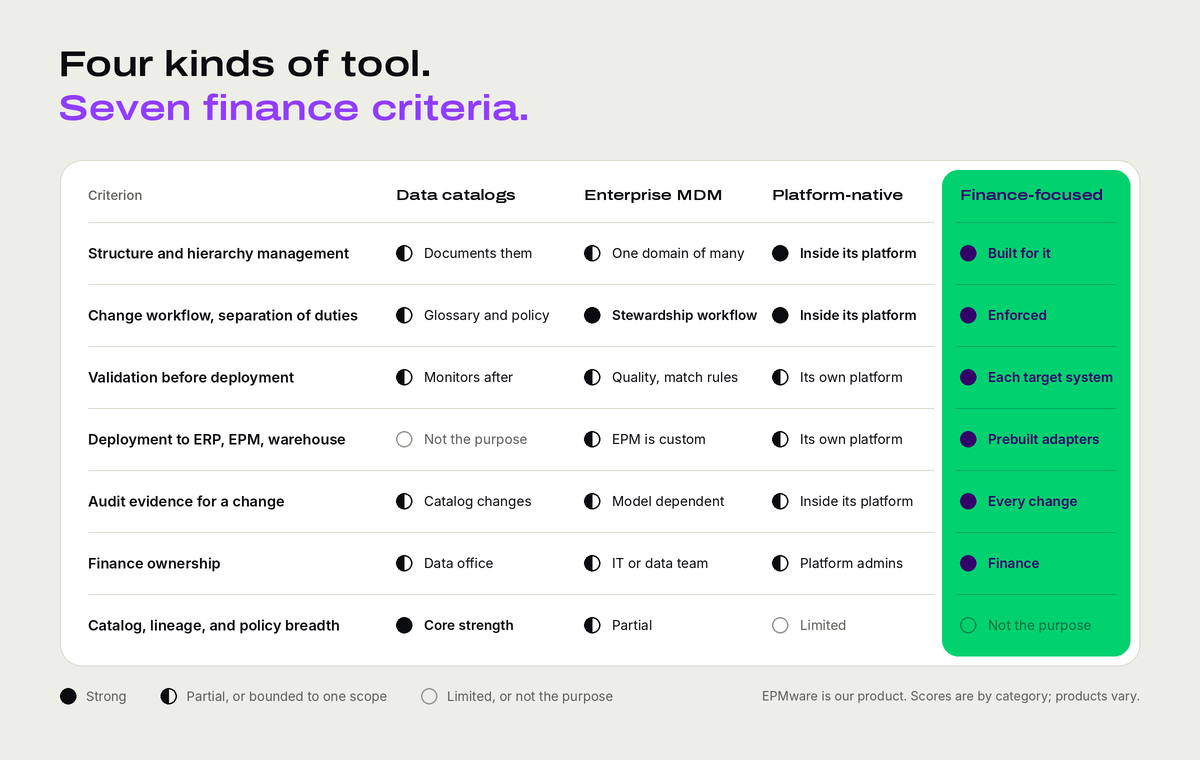
Four kinds of tool on seven finance criteria. Scores are by category; individual products vary.
| Criterion | Data catalogs and governance platforms | Enterprise MDM | Built into a finance platform | Finance-focused governance |
|---|---|---|---|---|
| Structure and hierarchy management | Documents them | Models them as one domain | Strong inside its platform | Built for it |
| Change workflow and separation of duties | For glossary and policy changes | Configurable stewardship workflow | Yes, inside its platform | Product feature, enforced |
| Validation before deployment | Data quality monitoring after the fact | Data quality and match rules | Against its own platform | Against each target system |
| Deployment to ERP, EPM, and warehouse | Not the purpose | Connectors, EPM is custom | Its own platform | Prebuilt adapters |
| Audit evidence for a change | For catalog changes | Available, model dependent | Inside its platform | Request to deployment, every change |
| Finance ownership | Data stewards and data office | IT or data team | Platform administrators | Finance |
| Catalog, lineage, and policy breadth | Core strength | Partial | Limited | Not the purpose |
Two things stand out. Catalogs and finance-focused governance are close to mirror images: each is strong exactly where the other does not try to compete. And platform-native tools score well on every finance criterion until the question crosses a system boundary, which is where most finance organizations now live.
Do you need a catalog and a finance governance tool?
Often, yes, and they work better together than either does alone.
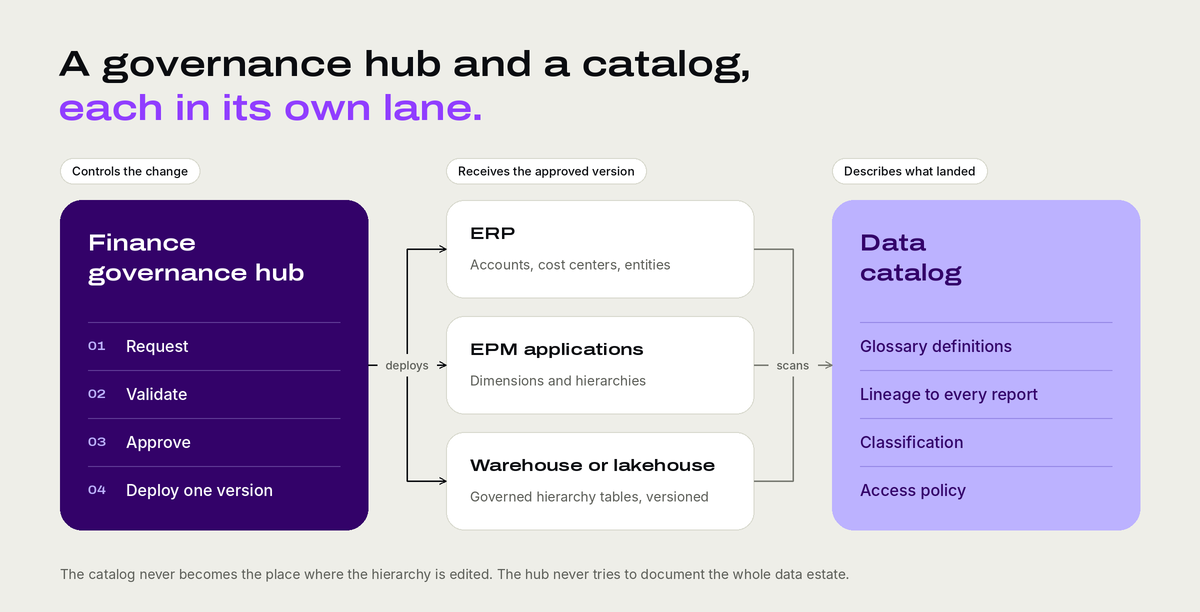
The hub controls the change. The catalog describes what landed.
In a well-run landscape the finance hub is where a hierarchy change is requested, validated, approved, and deployed. One of its targets is the warehouse or lakehouse, where the approved hierarchy lands as governed tables with a version and the approval record attached. The catalog then registers those tables like any other asset: it attaches the glossary definition of "Total Revenue", shows the lineage from the hierarchy table to every Power BI report that uses it, and applies the access policy.
Each tool stays in its lane. The catalog never becomes the place where the hierarchy is edited, and the finance hub never tries to document the whole data estate. If your catalog team and your finance systems team are each building a way to "govern the chart of accounts," this is the conversation to have before either project goes further. Our guide on syncing governed EPM hierarchies into Databricks shows the pattern in detail.
How to choose
Match the tool to the job in front of you.
- You need definitions, lineage, classification, and access policy across the enterprise: a data catalog and governance platform. Collibra for a formal stewardship program, Alation for adoption and discovery, Atlan for a cloud data stack, Purview for a Microsoft estate, Informatica if it is already your data management standard.
- You need to reconcile customer, product, or supplier records at scale: an enterprise MDM platform.
- Your governance boundary stops at one finance platform: its native tool. Oracle EDM, OneStream ACM, or SAP MDG.
- Your accounts, entities, and hierarchies must stay consistent across several ERPs, EPM applications, and a warehouse, with finance owning the process and audit evidence produced by it: finance-focused master data governance.
- More than one of the above: more than one tool. That is normal, and the comparison table shows why no single category covers all seven criteria.
Questions to ask before you shortlist
- Which job are we buying for: knowledge about data, or control over financial structures? If both, which first?
- How many systems consume our accounts, entities, and hierarchies today, and who keys a change into each?
- For one hierarchy change from last quarter, where is the approval, and how long would it take to produce?
- Which team will own the tool day to day, and do they understand the chart of accounts?
- Can the vendor show an approved change deploying into our actual ERP and EPM applications, not a diagram of it?
- If we already own a catalog, what exactly does it do today for the chart of accounts?
Common questions
What are the best data governance tools for financial systems leaders?
It depends on which governance job you mean. For definitions, lineage, classification, and access policy across the enterprise, the leading tools are data catalogs and governance platforms such as Collibra, Alation, Atlan, Microsoft Purview, and Informatica. For controlling changes to the chart of accounts, entities, hierarchies, and mappings across ERP, EPM, and warehouse systems, the options are platform-native tools such as Oracle EDM, OneStream ACM, and SAP MDG, or a finance-focused governance platform such as EPMware when the structures span more than one system.
What is the difference between a data catalog and master data management?
A data catalog governs knowledge about data: what it means, where it lives, where it flows, who may use it. Master data management governs the data itself: it is where master records and hierarchies are created, changed, approved, and distributed. A catalog can describe the chart of accounts. A master data tool is where the chart of accounts is maintained.
Is a data catalog enough for SOX controls over financial master data?
Usually not on its own. SOX testing of a hierarchy or chart of accounts change asks who requested it, who approved it, whether duties were separated, and when it reached each system. A catalog records changes to catalog content, such as definitions and policies. The change to the structure happens in the ERP, the EPM application, or a master data tool, so that is where the control and its evidence need to live.
Can Collibra, Alation, or Atlan manage the chart of accounts?
They can document it, define its terms, trace where it is used, and monitor its quality. They are not designed to be the system where accounts and hierarchies are authored, validated against consolidation rules, approved, and deployed into ERP and EPM applications. That work belongs to a platform-native tool or a master data governance platform.
Do I need both a data catalog and a finance master data governance tool?
Many enterprises do. The finance tool controls changes to financial structures and publishes approved versions to every system, including the warehouse. The catalog documents those published structures alongside the rest of the data estate, with definitions, lineage, and access policy. The two overlap very little.
Which data governance tools work with Oracle EPM and OneStream?
Oracle EDM governs metadata for Oracle EPM Cloud, and OneStream ACM governs change inside OneStream. When the same structures must stay consistent across both, or across an ERP and a warehouse as well, a finance-focused platform with prebuilt adapters for each, such as EPMware, governs the change once and deploys it to all of them.
Where EPMware fits, briefly
EPMware is a finance-owned master data governance platform: the fourth category in this guide. It governs the accounts, entities, hierarchies, and mappings that your ERP, EPM applications, and warehouse share, and it works alongside a data catalog rather than replacing one. If you want to see the comparison table scored against your own landscape, schedule a conversation and bring the hierarchy change your auditors asked about last year.
Sources: Collibra, About Collibra and Collibra Platform. Alation, Alation Ends the Era of Manual Data Governance. Microsoft, Unified Catalog in Microsoft Purview. Salesforce, Salesforce Completes Acquisition of Informatica. OneStream, Application Control Manager overview. SAP, SAP Master Data Governance.
Share this article


