.svg "EPMware")

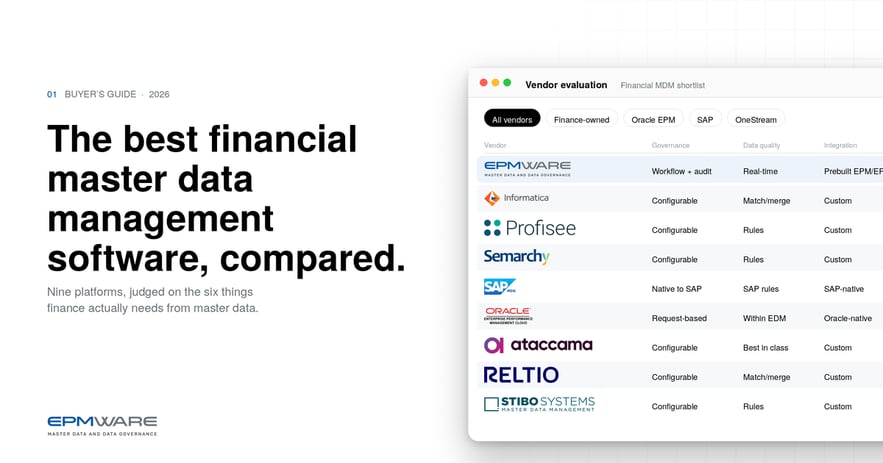
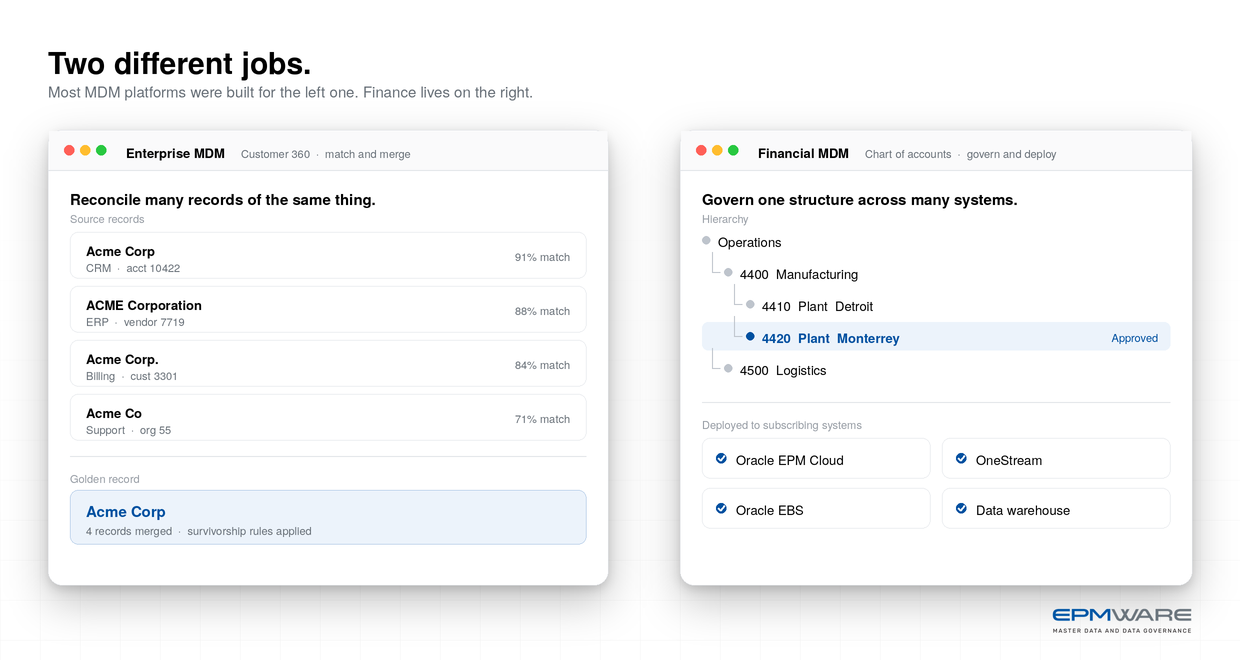
Search for the best financial master data management software and you will get the same ten-vendor roundup you get for every other kind of MDM. That is the problem. Most master data management platforms were built to reconcile customer and product records across an enterprise. Finance has a different job: keeping the chart of accounts, legal entities, cost centers, and hierarchies correct and consistent across the ERP, the EPM applications, and the data warehouse, on a close calendar that does not move.
This guide compares nine platforms through that lens. It covers the enterprise MDM leaders, the platforms finance teams reach for when replacing Microsoft MDS, Oracle's EPM-native option, and EPMware, a platform built specifically for finance. One disclosure before we start: EPMware is our product. We have tried to be fair to every vendor here, including naming the situations where another platform is the better choice.
What finance actually needs from master data management software
Finance systems leaders evaluate master data management software on six things, so those are the criteria for every platform below.
- Governance workflow: Can a change to an account, entity, or hierarchy be requested, reviewed, approved, and deployed through a controlled, auditable path?
- Data quality: Are duplicates, invalid properties, and naming violations blocked at the point of entry, or discovered later?
- Enterprise integration: Does the platform connect to your ERP, your EPM applications (Oracle EPM, Hyperion, OneStream, SAP), and your data warehouse without custom development?
- Business-user ownership: Can finance run it day to day without writing code or opening an IT ticket?
- Audit and versioning: Can you show who changed what, when, and why, and manage development, test, and production environments?
- Cost and licensing: What does it cost in licenses, implementation, and ongoing effort, and does the pricing model punish growth?
The best financial master data management software, compared
1. EPMware
EPMware is a master data management and data governance platform built for finance and EPM metadata. Business users request and enrich changes in a no-code interface, a configurable workflow routes reviews and approvals, real-time validation blocks bad metadata before it enters the workflow, and one-click deployment pushes approved changes to every subscribing system.
Strengths: Prebuilt, plug-and-play adapters for EPM Cloud, OneStream, SAP, Workday, NetSuite, EBS, Fusion, and Databricks, so enterprise integration is configuration rather than a build. Governance workflow, real-time validation, impact analysis, a full audit trail, and DEV, UAT, and PROD management are all native. The same code base runs in the cloud and on-premises. Licensing is enterprise-wide with unlimited node counts rather than per record, which matters to teams that outgrew record-based subscriptions.
Where it falls short: It is not built for heavy probabilistic matching and merging. If that is your primary problem, look at the multidomain leaders below.
Best for: Finance and financial systems teams that need governed, business-owned master data across EPM, ERP, and data warehouse systems, and teams replacing Oracle DRM or Microsoft MDS without adopting a general-purpose enterprise platform.
2. Informatica MDM
Informatica MDM runs on the Intelligent Data Management Cloud and is organized into domain applications such as Customer 360, Product 360, Supplier 360, and Finance 360. It is one of the most established names in master data management software.
Strengths: Deep data quality tooling, exact and fuzzy matching and merging with configurable survivorship, AI-assisted match tuning, and governance across many domains at enterprise scale.
Where it falls short: It is built for data engineering and MDM specialists, not finance users. Connecting it to EPM applications such as Hyperion, Oracle EPM, or OneStream is custom integration, and implementations are large programs with enterprise pricing.
Best for: Organizations whose primary need is enterprise-wide multidomain master data, where finance metadata is one piece of a much larger program.
3. Profisee
Profisee is a multidomain MDM platform known for faster time to value than the mega-vendors and for a strong fit with Microsoft environments, which makes it a frequent destination for teams leaving Microsoft MDS.
Strengths: A practical, modern multidomain platform with solid stewardship, matching, and governance features, and a clear migration story for Microsoft MDS customers.
Where it falls short: Like the other general-purpose platforms, it is not built around EPM metadata. Governing hierarchies for Oracle EPM or OneStream means custom integration work, and the platform is run by IT or a data team rather than finance.
Best for: Data teams replacing Microsoft MDS with a general multidomain MDM, especially in Microsoft-centric environments, where finance is one of several domains.
4. Semarchy
Semarchy xDM is a model-driven, unified data platform that combines master data management, data quality, and governance, and it is often shortlisted as an agile alternative to the larger enterprise suites.
Strengths: Flexible data modeling, quick iteration, strong stewardship interfaces, and a lighter implementation footprint than the mega-vendors. Another common Microsoft MDS replacement.
Where it falls short: It can store and model financial hierarchies, but it does not ship prebuilt adapters for EPM applications, so cross-system deployment to Oracle EPM or OneStream is custom, and the platform is IT-led.
Best for: Organizations that want an agile enterprise MDM across several domains and have the technical team to model and integrate it.
5. SAP Master Data Governance (SAP MDG)
SAP MDG governs master data within SAP landscapes, with the deepest integration of any platform into S/4HANA and the SAP ecosystem.
Strengths: Native governance of SAP master data objects, tight process integration with SAP applications, and a natural choice for SAP-standardized enterprises.
Where it falls short: Its strength is also its boundary. For finance teams running non-SAP EPM applications, or a mixed landscape of Oracle, OneStream, and SAP, MDG is a heavy, SAP-centric answer to a cross-platform problem, and it is administered by SAP specialists.
Best for: Enterprises standardized on SAP end to end, where master data governance can live inside the SAP stack.
6. Oracle Enterprise Data Management (Oracle EDM)
Oracle EDM is Oracle's first-party cloud service for managing enterprise data, hierarchies, and mappings, with native connectors for Oracle EPM Cloud and Oracle ERP Cloud.
Strengths: The deepest native integration into the Oracle EPM stack, first-party support, and inclusion in the EPM Enterprise Cloud bundle.
Where it falls short: EDM is Oracle-centric, so non-Oracle systems take more work, and it is typically run by technical EPM or IT staff. Licensing deserves a close read: EDM is not in the EPM Standard bundle, the Enterprise bundle has historically capped EDM at 5,000 records with additional capacity priced by volume, and subscriptions are named-user with multi-year terms.
Best for: Oracle-only environments on EPM Enterprise Cloud with modest record volumes and a technical team to run it. For a deeper look, see our comparison of Oracle EPM metadata management tools.
7. Ataccama ONE
Ataccama ONE unifies data quality, master data management, data catalog, and observability in a single platform, with a particularly strong reputation for data quality.
Strengths: Best-in-class data profiling and quality rules, AI-assisted matching, and a broad platform that appeals to enterprise data governance programs.
Where it falls short: It is an enterprise data platform, not a finance tool. EPM hierarchy governance and cross-application deployment are not native capabilities, and the platform is owned by data teams.
Best for: Enterprises running a broad data quality and governance program where MDM is one component.
8. Reltio
Reltio is a cloud-native, API-first MDM platform with a strong heritage in customer data and real-time master data delivery.
Strengths: Real-time, API-driven architecture, strong customer 360 capabilities, and modern SaaS delivery for large enterprises.
Where it falls short: Its center of gravity is customer and party data. Financial hierarchies and EPM metadata governance are far from its core use case, and it is an IT-owned platform with enterprise pricing.
Best for: Large enterprises whose primary MDM need is real-time customer or party data across many channels.
9. Stibo Systems
Stibo Systems' STEP platform is a multidomain MDM with deep roots in product information management, widely used in retail, manufacturing, and distribution.
Strengths: Excellent product and supplier data management, multidomain breadth, and strong supply chain fit.
Where it falls short: Financial master data is not its focus. Teams evaluating it for finance hierarchies across EPM and ERP systems will find little that is purpose-built for that job.
Best for: Product-centric enterprises that need PIM and multidomain MDM together.
Financial MDM software compared
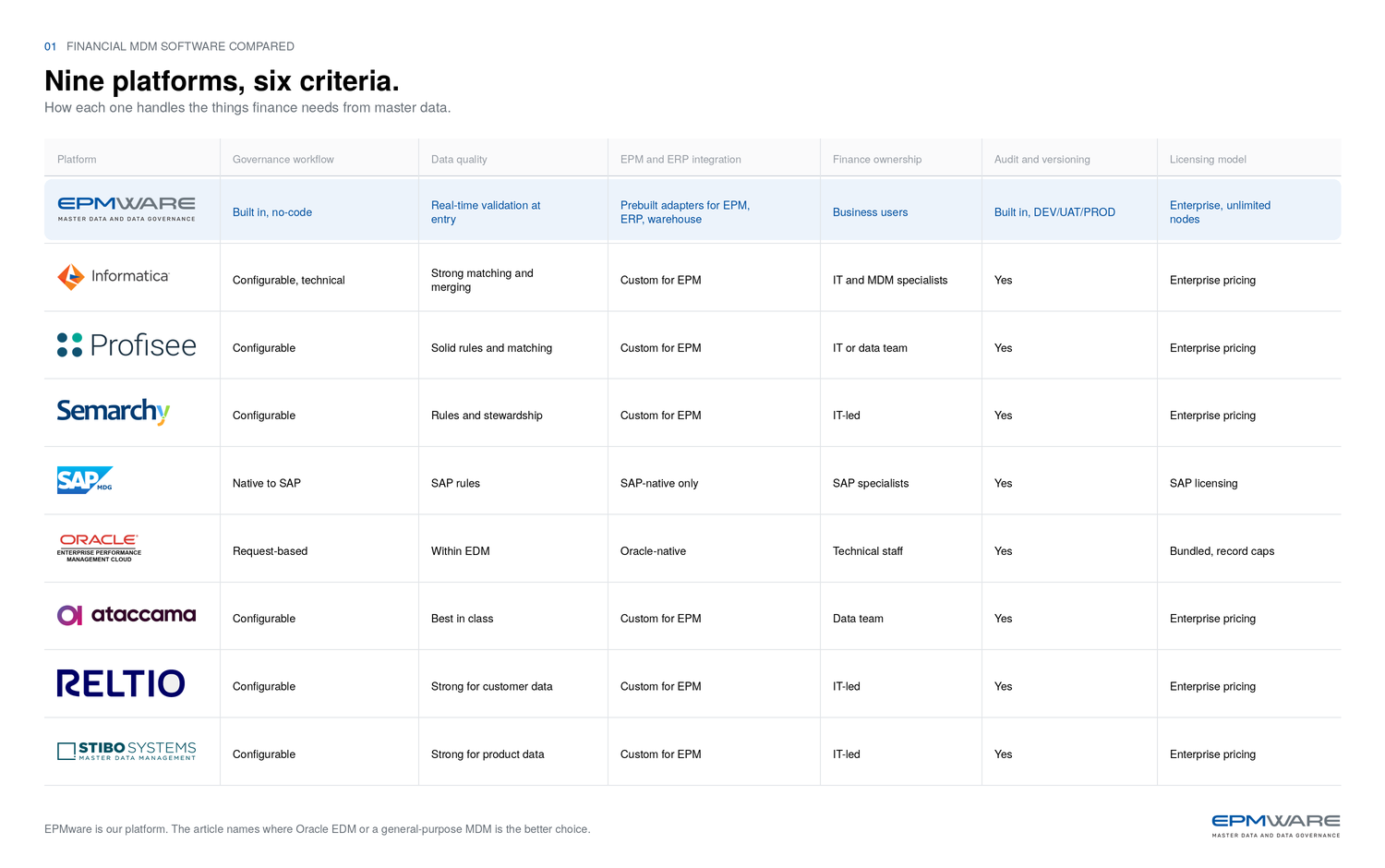
| Platform | Governance workflow | Data quality | EPM and ERP integration | Finance ownership | Audit and versioning | Licensing model |
|---|---|---|---|---|---|---|
| EPMware | Built in, no-code | Real-time validation at entry | Prebuilt adapters for EPM, ERP, and warehouse | Business users | Built in, DEV/UAT/PROD | Enterprise, unlimited nodes |
| Informatica MDM | Configurable, technical | Strong matching and merging | Custom for EPM | IT and MDM specialists | Yes | Enterprise pricing |
| Profisee | Configurable | Solid rules and matching | Custom for EPM | IT or data team | Yes | Enterprise pricing |
| Semarchy | Configurable | Rules and stewardship | Custom for EPM | IT-led | Yes | Enterprise pricing |
| SAP MDG | Native to SAP | SAP rules | SAP-native only | SAP specialists | Yes | SAP licensing |
| Oracle EDM | Request-based | Within EDM | Oracle-native | Technical staff | Yes | Bundled, record caps |
| Ataccama ONE | Configurable | Best in class | Custom for EPM | Data team | Yes | Enterprise pricing |
| Reltio | Configurable | Strong for customer data | Custom for EPM | IT-led | Yes | Enterprise pricing |
| Stibo Systems | Configurable | Strong for product data | Custom for EPM | IT-led | Yes | Enterprise pricing |
Replacing Microsoft MDS for finance master data
Microsoft has been winding down Master Data Services without shipping a direct successor, so many finance teams are choosing a replacement now. The instinct is to pick a general multidomain platform, and Profisee and Semarchy are the two most common destinations for exactly that reason. Both are capable.
The question worth asking first is what your MDS instance was actually doing. In many finance organizations, MDS held the chart of accounts, entity structures, and reporting hierarchies that feed the EPM and ERP systems. If that is your situation, a general MDM replaces the repository but not the job, and you will still need to build the integrations and the governance workflow around it. A finance-focused platform with prebuilt EPM and ERP adapters replaces the repository and the job at the same time.
Common questions about financial master data management software
What is the best financial master data management software?
It depends on the shape of your problem. For enterprise-wide customer and product data at scale, Informatica, Profisee, Semarchy, Ataccama, Reltio, and Stibo are all credible. For governing the accounts, entities, and hierarchies that feed EPM, ERP, and data warehouse systems, with finance owning the process, a purpose-built platform such as EPMware fits better, and Oracle EDM is the first-party option for Oracle-only environments.
How is financial MDM different from enterprise MDM?
Enterprise MDM reconciles many records of the same real-world thing, such as a customer, across systems, so matching and merging dominate. Financial MDM governs a smaller set of structural master data, such as the chart of accounts and hierarchies, where the challenge is controlled change, consistency across applications, and auditability rather than deduplication.
Can Profisee or Semarchy manage EPM metadata?
They can store and model hierarchies, but neither is built around EPM applications. Integrating them with Oracle EPM, Hyperion, or OneStream is custom work, and both are IT-led platforms. They make sense when EPM metadata is a small part of a broad multidomain program.
What should replace Microsoft MDS for finance master data?
If MDS was a general repository for several domains, a multidomain platform such as Profisee or Semarchy is a reasonable successor. If MDS held financial hierarchies that feed EPM and ERP systems, a finance-focused platform with prebuilt adapters and governance workflow replaces both the repository and the manual integration around it.
Is master data management software worth it for a finance team?
Yes when metadata changes are frequent, span several applications, or face audit scrutiny. The cost of manual governance shows up as failed loads, mismatched hierarchies, restated numbers, and days of reconciliation during close. A governed platform turns that into a controlled, auditable process that finance can own.
How to choose
Match the platform to the job. Enterprise-wide customer or product data with heavy deduplication: a multidomain leader. An SAP-only landscape: SAP MDG. An Oracle-only EPM landscape with modest record counts: Oracle EDM. Financial hierarchies that must stay consistent across EPM, ERP, and data warehouse systems, owned by finance and ready for audit: EPMware.
See it against your own systems
If you are evaluating financial master data management software or replacing Microsoft MDS or Oracle DRM, the fastest way to decide is to see governed master data deployed into your own EPM and ERP applications. Schedule a demo and bring your chart of accounts.
Share this article


