.svg "EPMware")

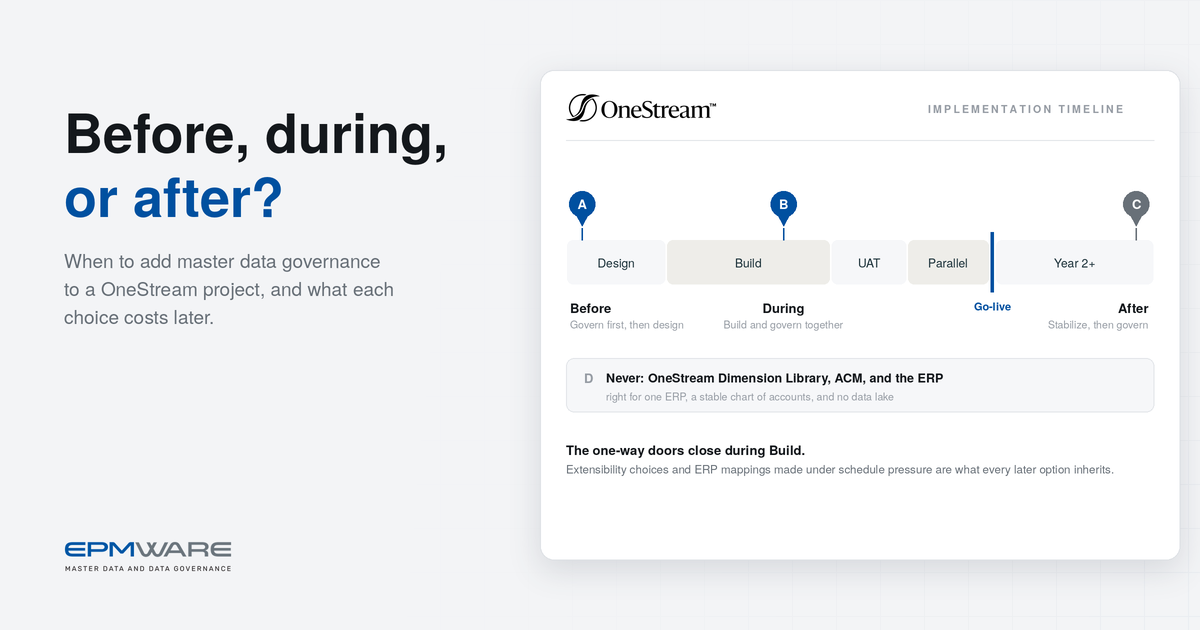
A OneStream implementation is one of the largest decisions a finance organization makes in a decade. It replaces the consolidation engine, the planning engine, and usually the reporting layer that the board reads. The business case is written around close speed, a unified platform, and the end of spreadsheet consolidation. Somewhere in the project plan, usually in a line item called "metadata build," sits the decision that determines whether any of that holds up after go-live: where the accounts, entities, and hierarchies that OneStream runs on will be owned, governed, and kept in sync with everything else.
That decision has four possible answers. Put governance in place before the OneStream project starts. Build it during the project, alongside the OneStream design. Add it after go-live, once the platform is stable. Or never add a separate layer, and rely on OneStream's own tools plus the ERP. Each answer is defensible in the right circumstances, and each has costs that tend to show up later than the benefits.
This guide is written for the finance executive team sponsoring the project, not the implementation team. It explains what OneStream actually asks of your metadata, using OneStream's own documentation, then walks through the four options with their benefits and downsides, and ends with a decision matrix and the questions to settle before the statement of work is signed. One disclosure: EPMware, our product, is a master data governance platform with a OneStream plug and play integration, also a OneStream technology and development partner, and it appears in the "hub" options below. We have tried to write the guide so that it is useful whether or not you ever evaluate us.
What a OneStream implementation asks of your metadata
It helps to be concrete about what "metadata" means in a OneStream project, because the word hides several distinct decisions, some of which are permanent.
Dimensions live in one library and are shared. OneStream manages entity, scenario, account, flow, and user-defined dimensions in the Dimension Library, and dimensions can be shared across multiple cubes. That is a strength: one Account dimension can serve consolidation, planning, and reporting. It also means that a bad decision in the Account dimension is a bad decision everywhere.
Entities carry more than a name. The Entity dimension holds currency, consolidation behavior, intercompany flags, ownership percentages, and eight text fields that business rules and transformation logic read. Several of these properties vary by scenario type and by time, so an entity's consolidation percentage in a forecast scenario can differ from its percentage in actuals, and both can change by period. Whoever maintains entities after go-live has to understand all of that, not just the hierarchy.
Some design decisions are one-way doors. OneStream's extensible dimensionality lets a parent cube and its child cubes share base dimensions while extending detail where it is needed. The documentation is blunt about the consequence: "You can only update from the Root dimension to a specific dimension once. Changing from a Root dimension is a one-time change that cannot be reverted if there is data in the cube." Parent members can move between dimensions later. Base members, once they hold data, cannot. The structure of your Account and user-defined dimensions is effectively fixed at the point data first lands.
Mappings are a second metadata layer. Every source system that feeds OneStream does so through transformation rules that translate source IDs into OneStream members. OneStream supports five mapping types, one-to-one, composite, range, mask, and list, with specific processing rules; composite rules stop at the first match, while range rules keep processing and the last matching rule wins. Rule groups are organized into rule profiles, which are assigned to workflow profiles for a given cube and scenario type. For a single ERP, this is manageable. For several, it becomes a parallel chart of accounts that somebody has to govern.
ACM governs change inside OneStream. Application Control Manager, OneStream's own tool for dimensionality and user security changes, provides a approval workflow for change requests, mass updates through Excel, and a Metadata File Import that compares a staged file against existing members and generates a request for the differences. It can import metadata from ERP systems, data warehouses, or MDM tools. Its scope is OneStream and is a free download on the Marketplace.
Put together, a OneStream implementation requires your organization to decide the account and entity structures, make irreversible extensibility choices, build and maintain mappings for every source, and set up a change process, all in the same months the project team is trying to configure consolidation rules and hit a parallel close. The question is not whether to govern metadata. It is when, and with what.
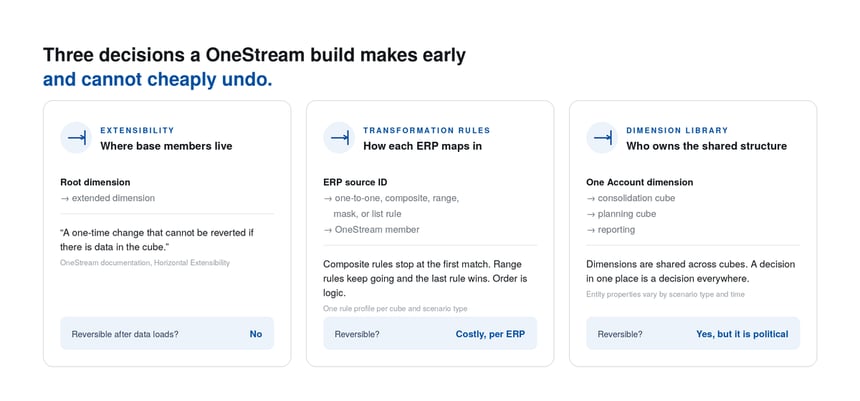
Three decisions a OneStream build makes early and cannot cheaply undo: where base members live, how each ERP maps in, and who owns the Dimension Library.
The ERP question, and the data lake question
Two features of your landscape change the answer more than anything else.
How many ERPs feed OneStream, and how often does that change? A single ERP with a stable chart of accounts means the ERP can plausibly remain the source of truth for accounts, with OneStream's Dimension Library mirroring it and transformation rules staying mostly one-to-one. Two or more ERPs, which is the normal state for any company that has acquired another company, means two or more charts of accounts, two or more entity masters, and a mapping layer in OneStream that reconciles them. Every ERP change ripples into mappings, and every mapping change is invisible to the ERP teams who caused it. Add a planned ERP migration during the OneStream project, which is common because both are often part of the same transformation program, and the chart of accounts is a moving target while the one-way extensibility decisions are being made.
Does a data warehouse or lake also need the hierarchies? Increasingly yes. OneStream's Fast Data Extract exports data and metadata for BI and warehouse consumption, and finance teams want Databricks, Snowflake, or Power BI to roll up revenue the same way the consolidation does. The moment a lake consumes OneStream hierarchies, you have a third copy of the structure, and the question of which copy is authoritative becomes unavoidable. If the answer is "OneStream," then every warehouse load depends on an export from the consolidation system. If the answer is "the hub," then OneStream and the lake are both subscribers to the same version.
Hold both questions in mind as you read the four options. A single-ERP company with no lake can reasonably choose differently than a multi-ERP company feeding Databricks or Power-BI.
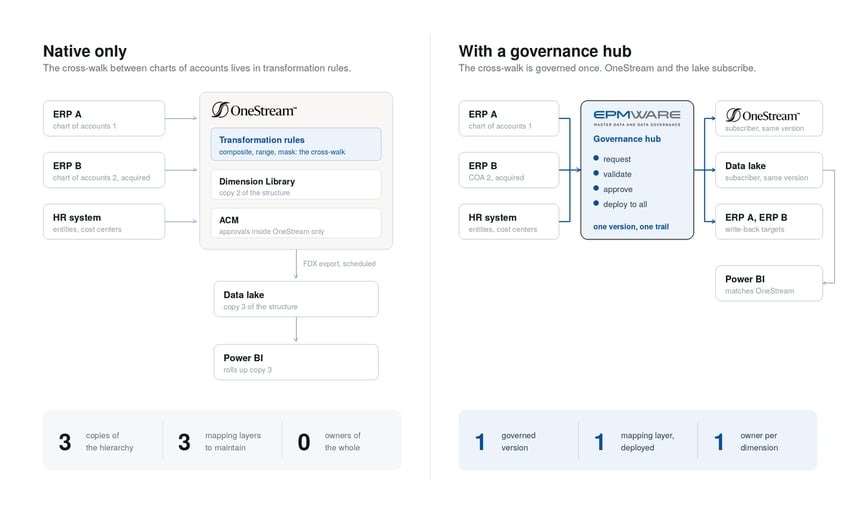
The same landscape under native-only governance and under a hub. The difference is where the relationships between charts of accounts live, and how many copies of the hierarchy exist.
Option A: Govern before the OneStream project
In this option, the organization stands up a master data governance hub before OneStream design begins. The chart of accounts and entity master are rationalized, ownership is assigned, approval workflows are defined, and the OneStream project then consumes a governed, versioned set of dimensions as an input rather than building them from scratch.
Benefits. The OneStream design team starts from a clean, rationalized structure, which shortens the design phase and reduces the number of late-stage changes that force rework in cubes and rules. The one-way extensibility decisions are made against a stable Account and user-defined dimension set. If several ERPs are in play, the cross-walk between them is already governed before transformation rules are written, so mapping becomes a deployment of known relationships rather than a discovery exercise during build. Go-live metadata is audit-ready on day one, with request and approval history from the start. Teams that migrate from Hyperion to OneStream also find that a hub lets them run both platforms from one governed source during the overlap, which simplifies parallel close.
Downsides. It adds a workstream and some elapsed time before the OneStream project proper begins, and it competes for the same finance systems people. There is a real risk of over-engineering governance for a structure that the OneStream design will reshape anyway, so the "before" work has to stay focused on the few dimensions and relationships that are expensive to change later. It also requires the organization to commit budget to governance before OneStream has delivered any visible value, which is a harder internal sell than it should be.
Fits best when: multiple ERPs feed the platform, an ERP migration is planned, a data lake will consume the hierarchies, or the current chart of accounts is known to be a mess. Also when there is a Hyperion or legacy DRM estate to retire, since the hub becomes the bridge.
Option B: Govern during the OneStream project
Here the governance hub is implemented in parallel with the OneStream build. Dimensions are designed in OneStream and governed in the hub from the first iteration, so that by UAT, every member in the Dimension Library arrived through a request, an approval, and a deployment.
Benefits. This is the most efficient use of the team's attention, because the people deciding the structure and the people governing it are in the same room at the same time. Governance is designed around OneStream's real constraints rather than guessed in advance: extensibility choices, Text field conventions, and workflow profile structure are all known. Mappings for each ERP are built once, in the hub, and deployed to OneStream, so the transformation layer is governed from the start. At go-live, the operating model is already proven in UAT rather than introduced to a tired team afterward.
Downsides. It raises the complexity of an already complex project. Two vendors, two project plans, and one integration between them have to be coordinated, and the systems integrator may be unfamiliar with the hub or reluctant to share design authority. If scope control is weak, the governance workstream can become a dumping ground for every data quality issue the OneStream build uncovers. Timing matters: starting the hub too late in the build means governing structures that are already locked, which is really Option C with extra cost.
Fits best when: the organization has a strong program office, the integrator is cooperative, and there is at least one ERP consolidation or lake requirement that makes native-only governance unattractive. This is the most common choice among larger OneStream customers that adopt a hub.
Option C: Govern after go-live
In this option, OneStream is implemented with its native tools, typically the Dimension Library maintained by administrators and ACM for change requests, and a governance hub is added in a later phase once the platform is stable.
Benefits. It keeps the OneStream project as simple as possible, which is attractive when the schedule is tight or the team is stretched. The organization learns what its real governance pain is before buying a solution for it, which can produce a sharper requirements list. Budget is spread across fiscal years. For a single-ERP company with no lake, this may be the right permanent state, not a deferral.
Downsides. The one-way doors are already closed. Whatever extensibility and dimension decisions were made during build are what the hub inherits, and if they were made under schedule pressure, the hub cannot undo them. Mappings for every ERP were built in OneStream's transformation rules by the integrator, in the integrator's conventions, and now have to be reverse-engineered into the hub. The audit trail for go-live metadata is whatever ACM and the project captured, which is often incomplete for the earliest, most consequential decisions. Most important, the business has learned to live without governance for a year, and the people who maintained metadata by hand have built their routines around it. Adding governance after the fact is a second change management effort, aimed at a team that just finished the first.
Fits best when: one ERP, a stable chart of accounts, no warehouse dependency, and a clear plan to revisit the decision at a defined point rather than letting it drift.
Option D: Native OneStream only
The fourth option is to never add a separate governance layer. The ERP remains the source of accounts and entities, OneStream's Dimension Library mirrors them, ACM handles change requests and security inside OneStream, and transformation rules absorb whatever differences exist.
Benefits. No additional software, vendor, or integration. ACM is a governance tool inside its boundary: approvals, Excel mass updates, metadata import with a compare step, and user security requests in the same workflow. For an organization whose governance boundary genuinely stops at OneStream, this is a great option, and it is cheaper than any alternative.
Downsides. The boundary is the problem. ACM governs change in OneStream; it does not reach the ERP where most account and entity changes originate, and it does not publish to a lake. Each ERP keeps its own chart of accounts, OneStream keeps its own dimensions, the lake keeps its own copy, and the relationships between them live in transformation rules and warehouse jobs that nobody owns end to end. Every reorganization or acquisition becomes a coordination problem across three or four teams. SOX evidence for a hierarchy change has to be assembled from several systems. And the Entity dimension's scenario-and-time-varying properties are maintained by administrators who become single points of failure.
Fits best when: a single ERP, low business approvals and change, no planned migration, no lake consuming hierarchies, and a small, stable finance systems team.
The decision matrix
The table below scores each option against the considerations that matter most to a finance executive. Treat it as a starting point and re-score it for your own landscape; the right-hand criteria will weigh differently for a two-ERP manufacturer feeding Databricks than for a single-ERP services firm.
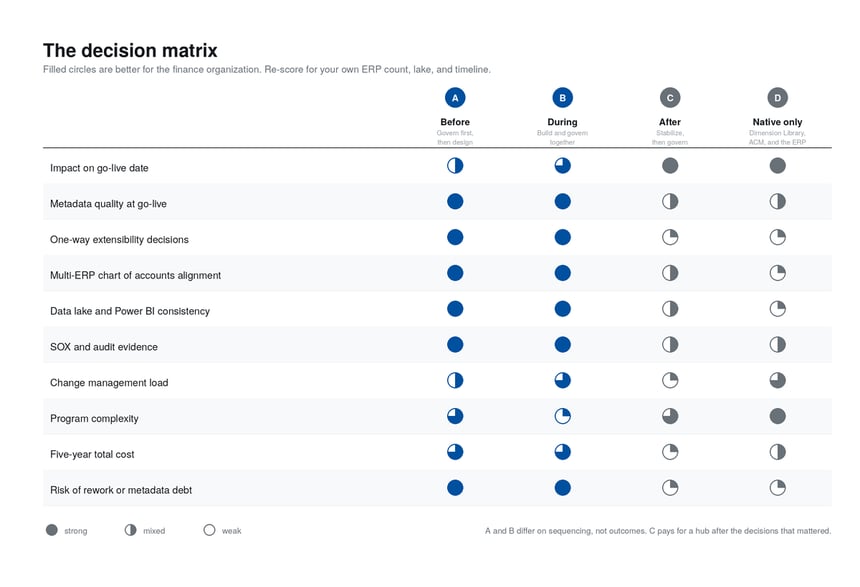
The decision matrix at a glance. Options A and B differ on sequencing more than outcomes; Option C carries the cost of a hub without its benefit at the moments that mattered.
| Consideration | A: Before | B: During | C: After | D: Native only |
|---|---|---|---|---|
| Impact on OneStream go-live date | Delays start, shortens design | Neutral if started early | None | None |
| Metadata quality at go-live | Highest | High | Depends on build team | Depends on build team |
| One-way extensibility decisions | Made on a governed structure | Made with governance present | Already made, inherited | Already made, unmanaged |
| Multi-ERP chart of accounts alignment | Governed before mapping | Governed during mapping | Reverse-engineered later | Lives in transformation rules |
| Data lake and Power BI consistency | Hub publishes to all | Hub publishes to all | Added later, with a gap | Export-based, drifts |
| SOX and audit evidence | Complete from day one | Complete from UAT | Gap for go-live decisions | Assembled from several systems |
| Change management load | Two sequential changes | One combined change | Two changes, a year apart | One change |
| Program complexity | Moderate, sequential | Highest, parallel | Low now, moderate later | Lowest |
| Total cost over five years | Moderate | Moderate | Higher, includes rework | Lowest license, highest manual effort |
| Risk of rework | Low | Low | High | Not applicable, debt instead |
Two patterns in the matrix deserve attention. First, Options A and B score similarly on outcomes and differ mainly on sequencing and program risk; the choice between them is about organizational capacity, not results. Second, Option C scores worse than Option D on several rows, because it carries the cost of a hub without the benefit of having it when the decisions that mattered were made. Choosing "after" is only better than "never" if the organization actually follows through.
Questions to settle before the statement of work
Whichever option you lean toward, the following questions should have written answers before the OneStream contract and the system integrator's statement of work are signed. They are the questions whose answers cannot be changed cheaply later.
- How many source systems will feed OneStream at go-live, and how many in three years? Count ERPs, HR systems that supply the entity or cost center structure, and any legacy EPM applications that will run in parallel. If the number is above one, decide now where the cross-walk between them will live.
- Is an ERP migration planned within the OneStream project's horizon? If so, decide which chart of accounts OneStream is designed against and who governs the transition.
- Will a data warehouse or lake consume OneStream hierarchies? If yes, decide whether the lake subscribes to OneStream exports or to the same source OneStream subscribes to. This is the question that decides whether your Power BI numbers will match your consolidation.
- Who owns each dimension after go-live, by name? Entities, accounts, flows, and each user-defined dimension. If the answer is "the OneStream administrator," decide whether that is a role or a person.
- What does the audit trail for a hierarchy change look like on day one? Walk through a hypothetical new entity: who requests, who approves, where the evidence lives, and how it reaches the ERP, OneStream, and the lake.
- Which extensibility decisions are irreversible, and who signs them off? Ask the integrator to list them explicitly. The documentation says base members cannot move between dimensions once data exists; make sure a finance owner, not only a consultant, understands which members those are.
- What is ACM's boundary in your design, and what sits outside it? ACM governs dimensionality and security inside OneStream. List what originates outside OneStream and how it gets in.
- If governance is deferred, what is the trigger to revisit it? A date, an acquisition, a lake project. Without a trigger, "after" becomes "never" by default.
What functional success looks like after go-live
Finance executives tend to measure a OneStream project by the first close on the new platform. The better measure is the second year, when the organization has absorbed an acquisition, reorganized a region, or added a planning cube, and the metadata had to change under load. Functional success, in that sense, looks like the following.
A new entity is requested once, by someone in finance, with its currency, consolidation behavior, and ownership percentages captured at request time rather than fixed by an administrator afterward. The request is validated against the rules that matter, including the ones that would break a workflow profile or a transformation rule, before anyone approves it. It is approved by the entity owner and the controller, with separation of duties enforced. It is deployed to the ERP where that applies, to the OneStream Dimension Library, and to the data lake in the same step, carrying the same version identifier. Power BI, reading the lake, rolls up the new entity exactly as the consolidation does. An auditor asking "who approved this and when" gets one answer from one place.
Transformation rules stay one-to-one wherever possible, because the governed cross-walk between ERPs removes most of the need for composite and range logic. The Entity dimension's time-varying properties are maintained through the same request process as the hierarchy itself. Reorganizations are modeled and approved before they deploy, with the prior structure preserved so that point-in-time reporting still works. And the OneStream administrator spends the close on OneStream, not on metadata.
None of this requires a particular vendor. It requires that the organization decided, before the one-way doors closed, where metadata would be owned and how it would reach every system that depends on it.
Common questions
Is OneStream ACM enough for enterprise metadata management?
ACM is sufficient when the governance boundary stops at OneStream: one ERP, a stable chart of accounts, and no downstream warehouse consuming hierarchies. It provides multi-level approval, Excel mass updates, and metadata import with a compare step. It is not designed to govern changes that originate in the ERP or to publish hierarchies to a data lake, so organizations with several ERPs or a lake dependency typically need a hub that sits upstream of ERP / OneStream and treats it as one subscriber.
When do you need more than OneStream ACM?
The usual triggers are a second ERP, a planned ERP migration, a data lake or Power BI estate that must roll up the same way OneStream does, a Hyperion or Oracle DRM estate being retired alongside the OneStream project, or audit findings that require a single evidence trail across systems. Any one of these moves metadata ownership outside OneStream's boundary, which is where ACM's scope ends.
What is enterprise master data governance for OneStream?
It is the practice of owning accounts, entities, and hierarchies in one governed place, with request, validation, approval, and audit, and deploying approved versions to OneStream, the ERPs, and the data warehouse together. OneStream's Dimension Library and ACM govern the OneStream copy; enterprise governance makes that copy one of several subscribers to the same version. A governance hub such as EPMware is one way to implement it, and it works alongside ACM rather than replacing it.
Should metadata governance be implemented before or after a OneStream go-live?
Before or during, if the organization has more than one ERP, a planned migration, or a data lake that will consume the hierarchies, because the extensibility and mapping decisions made during build are expensive or impossible to reverse. After, or never, can be the right answer for a single-ERP organization with a stable structure and no warehouse dependency, provided there is a defined trigger to revisit the decision.
How should multiple ERPs feed OneStream?
Each ERP needs a data source and transformation rules in OneStream, and the relationships between the ERP charts of accounts need an owner. Without a hub, those relationships live in composite and range mapping rules maintained by administrators. With a hub, the cross-walk is governed once and deployed as mostly one-to-one mappings, and changes in any ERP flow through the same request process as changes in OneStream.
Where EPMware fits, briefly
EPMware is a finance-owned master data governance hub with a prebuilt OneStream adapter, as well as adapters for Oracle EPM, Hyperion, SAP, Oracle Fusion, Workday, and Databricks (and many more). In Options A and B it is the hub that governs the structure OneStream consumes; in Option C it is the hub added later. It can also work alongside ACM, which continues to control change inside OneStream. If you want to see the matrix above scored against your own landscape, with your ERP count, your lake, and your project timeline, that is the conversation to have before the statement of work is signed, not after.
Our guide to EPMware for OneStream metadata governance covers the mechanics; this article was meant to cover the decision.
Share this article


