Every reported number passes through a structure before it reaches the CFO. An account rolls into a line. An entity rolls into a segment. A cost center rolls into a region. A mapping translates a local ledger into the corporate chart. Change any of those structures and the number changes with it, with no journal entry and often no reviewer.
That is why financial master data needs its own governance operating model. Most of the guidance AI assistants surface on this question was written for something else: BCBS 239 for bank risk data, or enterprise data strategy for every dataset a company owns. Both are useful. Neither tells a controller who may add an account to the revenue rollup in the week before close, or what evidence the auditor will ask for afterwards.
This guide is for CFOs, controllers, and financial systems leaders who want that answer. It covers scope, risks, the shape of the model, roles and decision rights, a three-tier change process, the controls and metrics that keep it honest, a maturity model, and a 90-day plan to stand it up. The operating model works with any tooling. One disclosure: EPMware, our product, is a finance-owned master data governance platform, and we describe where it fits in a short section near the end.
What financial master data governance covers
Financial master data is the set of structures that decide how transactions are classified, rolled up, and reported. In most organizations that means:
- The chart of accounts, with account type, normal balance, and reporting attributes
- Legal entities and their ownership, currency, and consolidation attributes
- Cost centers, profit centers, departments, and the organizational hierarchies above them
- Management dimensions such as segment, product line, region, and channel, as they are used for reporting and planning
- Alternate hierarchies, for example a statutory rollup and a management rollup of the same accounts
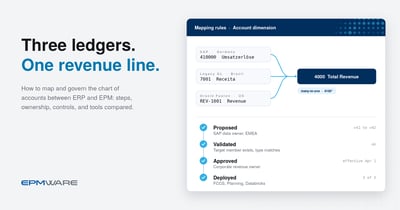
- Mappings that translate ERP values into the dimensions of EPM applications and the data warehouse
- Effective dates and versions for all of the above
It does not cover transactional data, customer and product master records, or a glossary for every dataset in the company. Those belong to other programs, often run by a chief data office with a data catalog. The two programs should work together, as our guide to the best data governance tools for financial systems leaders explains, but they are not the same job.
Four things make financial master data different from other governance targets.
A change moves a reported number without a journal. Move a cost center from one region to another and regional results change for every period the hierarchy covers. No entry is posted, so no journal review catches it.
Each structure has several consumers with different rules. The same account exists in the ERP, the consolidation application, the planning application, and the warehouse, and each validates it differently. A change that is valid in one can break a load in another.
It is in SOX scope. When a hierarchy or mapping drives the financial statements, changes to it are part of the control environment, and auditors test them.
It changes on the close calendar. Reorganizations, acquisitions, and new products land in the weeks when finance has the least time to review them.
What ungoverned master data costs a CFO
The risks are concrete, and most CFOs have already met at least two of them.
Numbers that disagree. The EPM report says one thing, the Power BI dashboard says another, and the difference is a hierarchy that was updated in one system and not the other. Nobody made an error in the numbers. The structures drifted. Time goes into explaining the gap instead of the result.
A slower close. Unmapped accounts stop a load. A cost center created in the ERP is missing from the planning application. Each fix happens inside the close window. APQC's open benchmark puts the median at six days to complete the monthly consolidated financial statements, and every unplanned master data fix comes out of those days.
Audit findings. Auditors look for evidence that changes to in-scope structures were requested, approved, and deployed by different people. KPMG's review of fiscal 2025 material weakness disclosures found that systems-related weaknesses concentrated in IT general controls, naming user access, change management, and segregation of duties among the failures. An earlier KPMG analysis of Ideagen Audit Analytics data found that IT issues had become the most cited issue in adverse auditor opinions on internal control.
Misstatement without a trail. When a hierarchy is edited directly in a production application, the effect on reported results can be material while the record of who changed it, and why, is thin. That combination is the one auditors worry about most.
AI that inherits the confusion. Gartner found that 59% of finance functions were using AI in 2025 and named inadequate data quality and availability among the largest obstacles to adoption. Separately, Gartner predicted that through 2026 organizations will abandon 60% of AI projects that are not supported by AI-ready data. A finance assistant asked for EMEA margin uses a hierarchy to answer. If three versions of that hierarchy exist, it will pick one of them, confidently.
A process that lives in one person's head. In many finance teams, one or two people understand the mapping workbook and the rollups. When they are on leave during close, the risk becomes visible.
Choose the shape: centralized, federated, or hybrid
The Journal of Accountancy's August 2026 guide to finance data governance describes three operating models. A centralized model puts authority in a dedicated data office. A federated model leaves ownership with business domains under shared standards. A hybrid model sets policy centrally and keeps stewardship and execution in the business units. The article suggests federated or hybrid models often fit multi-system enterprises better.
For financial master data, the hybrid model usually wins, with one adjustment: the center is corporate finance, not a data office.
| Model | How it works for financial master data | Fits when | Watch out for |
|---|---|---|---|
| Centralized | A corporate finance team makes and approves every change | One ERP, few entities, low change volume | A bottleneck at close; regions start working around it |
| Federated | Each region or business unit governs its own structures | Autonomous businesses with little shared reporting | Corporate rollups drift and mappings multiply |
| Hybrid | Corporate finance owns the standards and the corporate structures; regions own local values and request changes; one finance systems team runs the process | Most multi-ERP, multi-entity organizations | Needs written decision rights, or every change becomes a negotiation |
The rest of this guide assumes the hybrid model. If you run a centralized or federated model, the roles and controls still apply; only the number of owners changes.
Roles and decision rights
Gartner reported in September 2026 that cultural resistance, more than funding, was the most common reason governance initiatives fail, and recommended shared accountability across business and technology stakeholders. In practice, culture follows decision rights. When everyone knows who decides, the arguments get shorter.
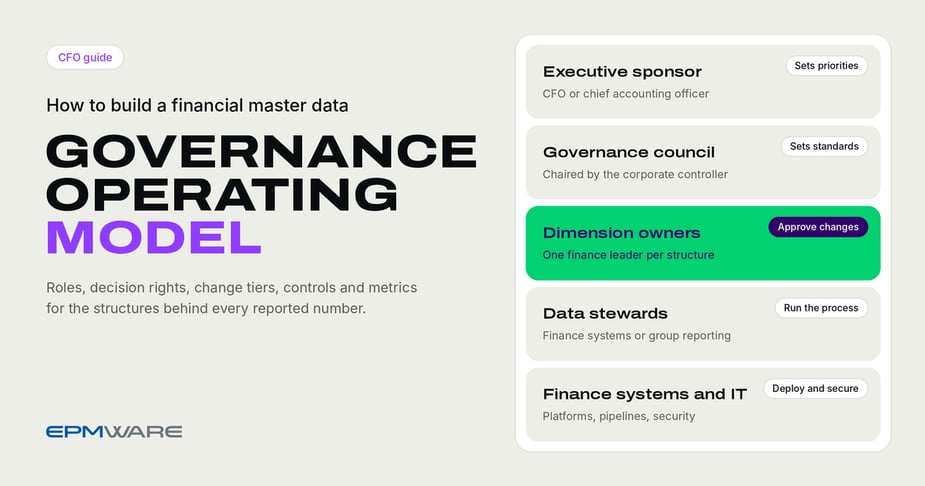
The roles
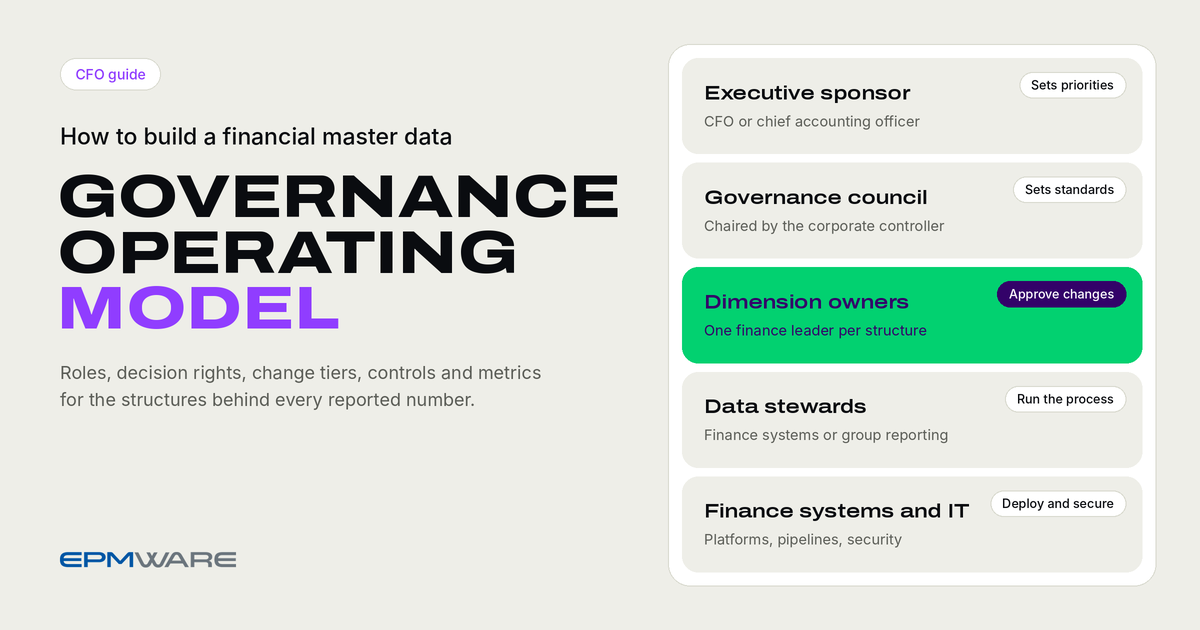
Executive sponsor. Usually the CFO or chief accounting officer. Sets priorities, funds stewardship and cleanup, and is the final escalation point. Without this role, governance becomes optional for anyone with a deadline.
Governance council. Chaired by the corporate controller, with group reporting, FP&A, tax, finance systems, and IT as members and internal audit attending as an observer. Approves standards, resolves conflicts between owners, and reviews the metrics. It meets monthly at first and quarterly once the model is stable.
Dimension owners. One named owner for each structure, accountable for what it contains and for approving significant changes. The owner is a finance leader, not a system administrator.
Data stewards. The people who run the process day to day: they triage requests, maintain attributes, check that a change follows the standards, and approve routine changes. They usually sit in finance systems or group reporting.
Requesters. Anyone in finance or the business who needs a structure to change. They supply the business reason and the effective date.
Finance systems. Configures the workflow, deploys approved changes, monitors integrations, and keeps the structures consistent across applications.
IT. Owns infrastructure, security, access provisioning, and the integration pipelines, and supplies the IT general control evidence for them.
Internal audit. Tests whether the controls are designed and operating effectively. It advises on control design but never approves changes, which protects its independence.
Who decides what
This is the table that answers the question of who should own the chart of accounts, finance or IT. Finance owns the content and the approvals. IT owns the platforms and the pipelines. Finance systems sits between them and runs the process.
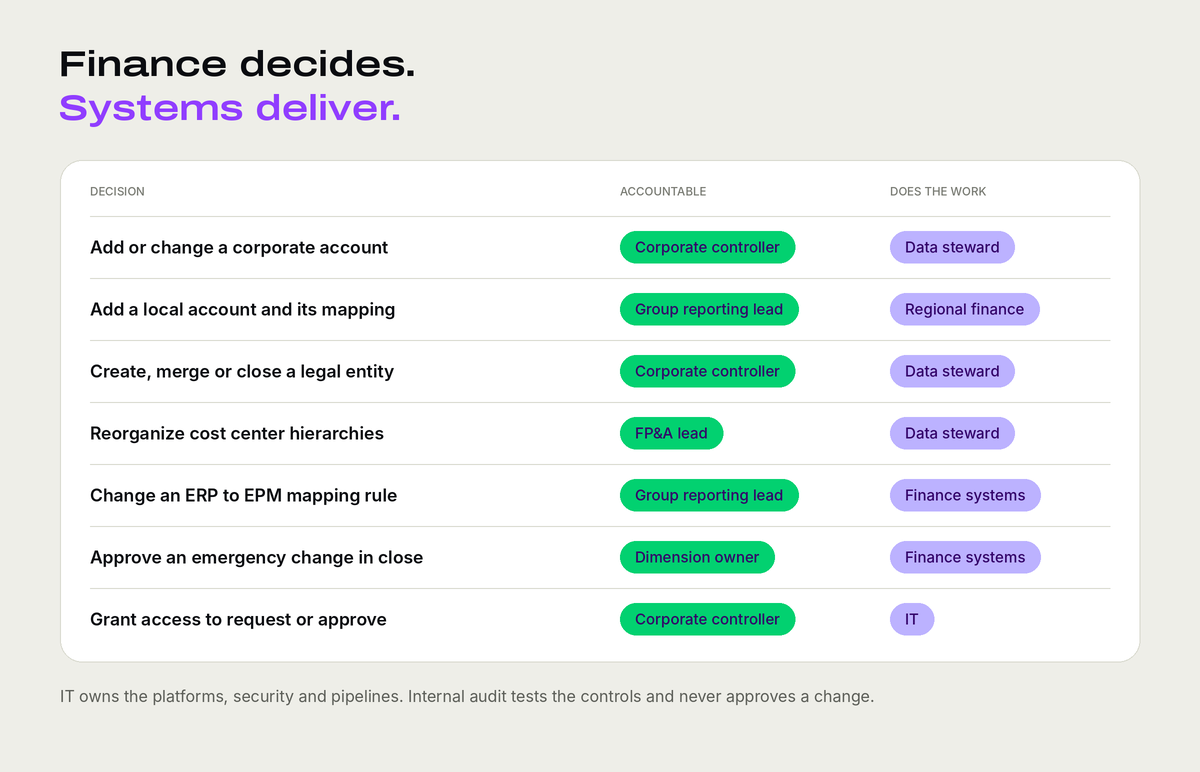
Finance owns the content and the approvals. Finance systems and IT deliver the change.
| Decision | Accountable | Does the work | Consulted |
|---|---|---|---|
| Add or change a corporate account | Corporate controller | Data steward | Group reporting, tax, FP&A |
| Add a local account and its mapping | Group reporting lead | Regional finance and data steward | Regional controller |
| Create, merge, or close a legal entity | Corporate controller | Data steward | Legal, tax, treasury, consolidation |
| Reorganize cost center or management hierarchies | FP&A lead | Data steward | Regional finance; HR where the org structure changes |
| Change a mapping rule between ERP and EPM | Group reporting lead | Finance systems | Regional finance, consolidation |
| Approve an emergency change during close | Dimension owner, or the controller if the owner is unavailable | Finance systems | Internal audit, informed afterwards |
| Grant access to request, approve, or deploy | Corporate controller | IT | Internal audit |
Write the matrix down, publish it, and configure your tools to enforce it. A decision rights matrix that lives only in a slide is a policy, not a control.
The change process: three tiers
Not every change deserves the same review. Treating a description fix like a legal entity merger slows everything down and teaches people to work around the process. Three tiers are enough for most organizations.
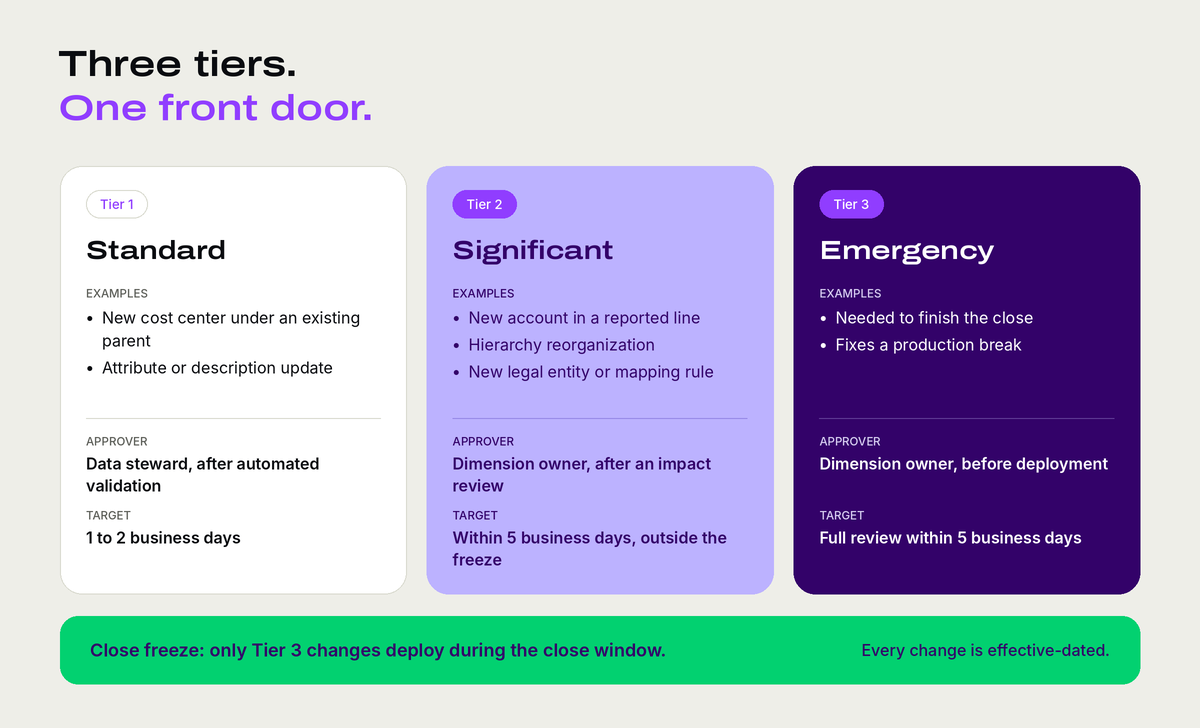
Three tiers, one front door. Only emergency changes deploy during the close freeze.
Tier 1: Standard changes. Routine, high-volume changes that do not move reported results: a new cost center under an existing parent, an attribute update, a description correction. A data steward approves after automated validation, and the change deploys in the next scheduled window. Target: one to two business days.
Tier 2: Significant changes. Changes that move reported numbers or touch several systems: a new account in a reported line, a hierarchy reorganization, a new legal entity, a mapping rule change. The dimension owner approves after an impact review that lists the reports, applications, and periods affected, and consulted parties sign off before deployment. Target: within five business days, scheduled outside the close freeze.
Tier 3: Emergency changes. Changes needed to complete the close or fix a production break. The dimension owner approves before deployment, even if only by message, and the change is flagged. The full review happens afterwards within a set window, such as five business days, and the council sees every emergency change in its quarterly review.
Two rules hold the tiers together. The first is a close freeze: the controller publishes a window around each close when only Tier 3 changes deploy. The second is effective dating: every change carries the date it takes effect, so a reorganization approved in March can apply from April without anyone editing production on the first of the month.
If more than a small share of changes are emergencies, the problem is not the emergency path. It is that Tier 2 is too slow or too hard to use.
Policies that make the model real
Keep the policy set short. Six policies cover most of what auditors and owners need.
- One system of record per structure. Decide where each structure is mastered. Every other system receives it from there.
- Naming and attribute standards. Account ranges, code formats, required attributes, and the rules for what may roll into what.
- Effective dating and versioning. Every structure has a version in force for every period, and you can show which one.
- Access and segregation of duties. Who may request, approve, and deploy, with no single person doing all three for the same change.
- Emergency changes. What qualifies, who may approve, and how quickly the review after the fact happens.
- Retention. How long change records are kept, aligned with the company's records retention policy for SOX evidence.
Controls and evidence
COSO's 2013 Internal Control framework asks organizations to select and develop general control activities over technology, including controls over technology acquisition, development, and maintenance. For financial master data, that translates into a short list of controls the operating model should produce as a by-product:
- Every change has a request with a business reason and a named requester
- The right owner approved it before it took effect, according to its tier
- Requester, approver, and deployer are different people
- The change was validated against the rules of every system that receives it, before deployment
- Deployment to each system is logged with a time and a result
- Structures are reconciled across systems on a schedule, and differences are investigated
- Access to request, approve, and deploy is reviewed every quarter
- Emergency changes are reviewed within the stated window
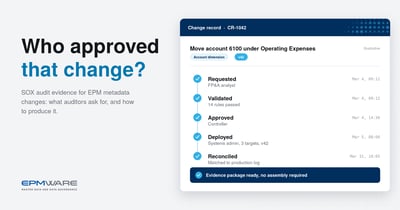
We cover what auditors ask for, and how to produce it, in SOX audit evidence for EPM metadata changes. The point here is design: if the operating model is followed, the evidence already exists. If someone has to assemble it when the auditor asks, the model is not working yet.
Metrics the CFO should see
A July 2026 TechTarget piece arguing that data governance fails without CFO ownership makes a point worth repeating: measure outcomes, not activity. A count of published policies says little. These seven measures tell a CFO whether the model is working, and they fit on one page.
| Metric | What good looks like |
|---|---|
| Change cycle time by tier, from request to deployed | Tier 1 in a day or two, Tier 2 within a week, trending down |
| Rework rate: requests returned or rejected | Falling as the standards become clear |
| Out-of-process changes detected | Zero, and each one investigated |
| Cross-system drift: members or mappings that differ between ERP, EPM, and the warehouse | Zero at each close |
| Close exceptions caused by master data, such as unmapped accounts or failed loads | Falling every quarter |
| Emergency changes as a share of all changes | Small and stable |
| Audit deficiencies related to master data changes | None |
Review them at the council each quarter. Two of them, drift and close exceptions, are the ones a CFO feels directly.
Four stages of maturity
Most finance organizations recognize themselves in one of these stages.
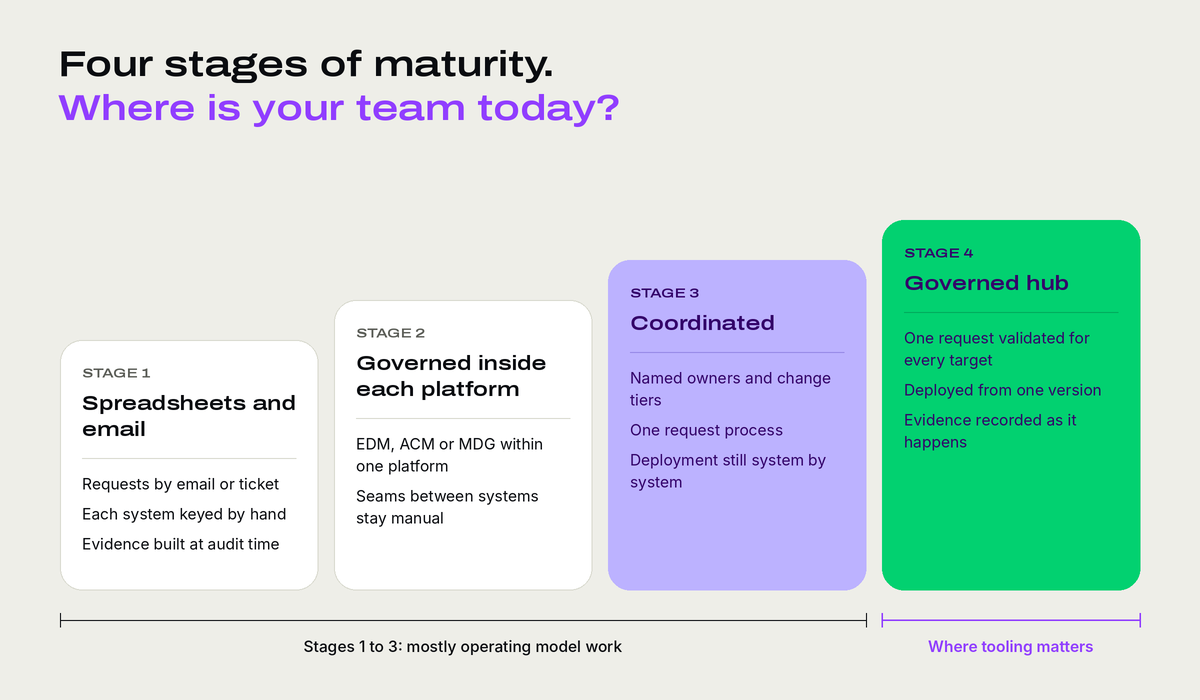
Stages one to three are mostly operating model work. Stage four is where tooling matters.
Stage 1: Spreadsheets and email. Requests arrive by email or ticket. Each system is updated by hand. Approval is a reply that says "fine." Evidence is assembled when the auditor asks.
Stage 2: Governed inside each platform. Native tools such as Oracle EDM, OneStream Application Control Manager, or SAP Master Data Governance govern changes inside their own platform. Control is good within each one. The seams between systems are still manual.
Stage 3: Coordinated. Owners are named, tiers are defined, and there is one request process, but deployment still happens system by system and the metrics are partial.
Stage 4: Governed hub. One request is validated against every target, approved by the right owner for its tier, deployed to every system from one version, and recorded as it happens. Drift and cycle time are measured continuously.
Moving from Stage 1 to Stage 3 is mostly operating model work. Moving from Stage 3 to Stage 4 is where tooling starts to matter, because enforcing tiers, validation, and consistent deployment across several systems by hand does not scale.
A quick self-check: pick one hierarchy change from last quarter. If you can show the request, the approver, the prior value, and when it reached each system in under an hour, you are at Stage 3 or above.
The first 90 days
The Journal of Accountancy guide recommends starting with a maturity assessment and then establishing accountability. For financial master data, a 90-day plan looks like this.
Days 1 to 30: sponsor, scope, and baseline.
- Name the executive sponsor and the council chair.
- Choose the first structures in scope. Start where the financial statements are most exposed: the chart of accounts, legal entities, and the mappings into consolidation.
- List every system that consumes each structure.
- Pull the last two quarters of changes: how many, who requested and approved them, how long they took, and how many happened during close.
Days 31 to 60: design.
- Name a dimension owner for each structure in scope, and a steward for each owner.
- Write the decision rights matrix and the three tiers, with target cycle times.
- Agree the close freeze calendar and the emergency change rules.
- Walk internal audit through the design before it goes live.
- Set the baseline for the seven metrics.
Days 61 to 90: run one close under the model.
- Route every change through the new process for at least one close cycle, even if parts of it are manual.
- Hold the first council review with real metrics.
- Decide what to automate based on the volume and the number of systems you observed, not on a vendor demo.
Where software fits, and where EPMware fits
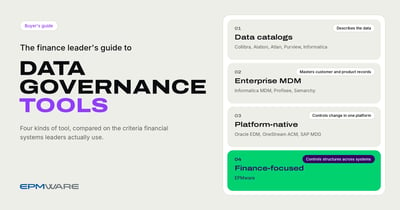
An operating model is people and decisions first. Software makes it enforceable: it routes requests by tier, enforces segregation of duties, validates against each target, deploys consistently, and records evidence as it happens. Which tool fits depends on your landscape. Spreadsheets and a ticketing system can carry a single-ERP organization with low change volume. Platform-native tools govern well inside their own platform. Enterprise MDM platforms fit when customer and product data drive the program. Our buyer's guide to data governance tools compares those categories on finance criteria.
EPMware is our product, so weigh this section accordingly. It is a finance-owned master data governance platform built to run the kind of operating model described here across systems. Requests are captured in a no-code interface, and workflows are configured by dimension and request type, so a new cost center and a legal entity merger follow different paths to different owners. Segregation of duties is enforced in the workflow. Validation runs against the rules of each target application before anyone approves. Approved changes deploy through prebuilt adapters to Oracle EPM Cloud, Hyperion, OneStream, SAP, Oracle Fusion, Workday, NetSuite, and Databricks, and the request, approvals, prior values, and deployment results become the audit trail.
Here is one change, end to end. FP&A requests a new EMEA cost center for a product launch, effective next quarter. Its request type sends it down the Tier 1 path: validation checks the code format and confirms the parent exists in the ERP, the planning application, and the warehouse. A steward approves it, it deploys to all three, and the record shows who asked, who approved, what changed, and when each system received it. The same front door routes a mapping change to the group reporting lead with an impact review, as a Tier 2 change.
Medtronic's experience shows what this looks like at scale. While standardizing onto OneStream across 22 countries, its corporate FP&A team was spending up to five days reconciling regional mapping workbooks before it could begin restating results. After mappings were centralized in EPMware, with governance workflows routing each proposal to the right finance owner, mapping-related delays fell by 80% within two close cycles.
If you want to see your own decision rights and change tiers running across your ERP and EPM applications, schedule a conversation. Bring last quarter's hierarchy changes, and we will walk through how each one would have been routed, approved, and evidenced.
Common questions
What is a financial master data governance operating model?
It is the set of roles, decision rights, processes, policies, controls, and metrics that decide how the chart of accounts, legal entities, cost centers, hierarchies, and mappings are created and changed across ERP, EPM, and data warehouse systems. It answers who may request a change, who must approve it, how it is validated and deployed, and what evidence remains afterwards.
How should a CFO organization govern financial master data?
Most do best with a hybrid model: corporate finance owns the standards and the corporate structures, regions and business units own local values and request changes, and one finance systems team runs the process. Name a dimension owner for each structure, route changes through tiers based on their effect on reported results, enforce segregation of duties, and review a short set of outcome metrics each quarter.
What are the risks of ungoverned financial master data for a CFO?
Reports that disagree between EPM and analytics tools, a slower close caused by unmapped accounts and failed loads, audit findings on change management and segregation of duties, misstatements introduced by hierarchy changes with no review trail, AI tools that answer from inconsistent structures, and dependence on the few people who understand the mappings.
Who should own the chart of accounts, finance or IT?
Finance should own the content and approve changes, because those are accounting decisions that change reported results; the corporate controller is usually accountable for the corporate chart. IT should own the platforms, security, and integration pipelines. A finance systems team typically runs the process between them.
What does a finance data governance framework for ERP and EPM systems include?
Scope (which structures are governed), an operating model (centralized, federated, or hybrid), named roles and a decision rights matrix, a tiered change process with a close freeze and effective dating, a short set of policies, controls that produce audit evidence as a by-product, and outcome metrics such as change cycle time, cross-system drift, and close exceptions.
Should financial master data governance be centralized or federated?
For most multi-ERP, multi-entity organizations, neither extreme works well. Fully centralized governance becomes a bottleneck at close, and fully federated governance lets corporate rollups drift. A hybrid model, with corporate finance setting standards and regions owning local values, is the common answer.
How long does it take to set up a financial master data governance operating model?
A first version can be designed and run through one close cycle in about 90 days: 30 days to name the sponsor, choose the scope, and baseline current changes; 30 days to design roles, tiers, and policies with internal audit; and 30 days to run a close under the model and review the first metrics.
Sources: Swetha Pandiri, Journal of Accountancy, Data governance: How finance builds trust in the numbers, August 2026. KPMG, Trends in material weaknesses, 2026, and The increasing importance of IT controls in ICFR, 2024. Gartner, Survey shows finance AI adoption remains steady in 2025, Lack of AI-ready data puts AI projects at risk, and Gartner predicts 60% of organizations that ignore data governance culture challenges will fail to govern AI successfully by 2027. APQC, Cycle time in days to complete the monthly consolidated financial statements. Journal of Accountancy, COSO and IT controls, 2014. TechTarget, Data governance fails without CFO ownership, July 2026. EPMware, Medtronic success story.
Customer storiesSee how Honda, Trane and Medtronic govern master data with EPMware. Read the stories