.svg "EPMware")

It's close week. At 11 p.m., a consolidation load fails. The culprit isn't your team, your ERP, or your consolidation tool. It's a single new cost center that was created in the source system last Tuesday and never made it into the hierarchy your consolidation depends on. Someone opens a flat file, hand-edits the member, reruns the load, and goes home. The number is wrong until it isn't—and no one is entirely sure when it became right.
If that scenario feels familiar, you don't have a people problem or an effort problem. You have a master data problem. And for finance organizations running on Hyperion, OneStream, Oracle EPM, SAP, or any combination of the above, it is quietly one of the most expensive problems on the books.
What Is Financial Master Data Management?
Financial master data management (MDM) is the practice of maintaining a single, governed source of truth for the accounts, entities, cost centers, and hierarchies that drive financial reporting. It keeps every EPM, ERP, and reporting system in sync, so consolidations, allocations, and reports are built on consistent, auditable data.
Master Data Is the Scaffolding Behind Every Number You Report
In a financial systems context, "metadata" and "master data" aren't abstractions. They're the accounts, entities, cost centers, products, and hierarchies that give every transaction its meaning. They're the dimensional scaffolding that consolidations, allocations, plans, and reports are built on top of.
When that scaffolding is accurate and consistent across systems, finance runs quietly. When it drifts—when the account structure in your ERP no longer matches the hierarchy in your EPM platform, which no longer matches the tree in your reporting warehouse—everything downstream inherits the error. Loads fail. Reports foot to different totals. Analysts spend the first three days of close reconciling structures instead of explaining results. And eventually, an auditor asks a question no one can answer cleanly: who changed this, when, and why?
The uncomfortable truth is that in most organizations, financial master data is still maintained the way it was fifteen years ago—manually, in parallel, one system at a time, held together by spreadsheets, macros, and the institutional memory of one or two people you can't afford to lose.
Two Ways to Manage Financial Master Data
There are really only two architectural approaches, and the difference between them determines whether your master data is an asset or a liability.
Decentralized master data. Every application maintains its own copy of the accounts, entities, and hierarchies, and each copy is kept in sync by hand. There is no shared definition, no shared vocabulary, and no single owner. This is the default state most finance teams inherit rather than choose—and it's precisely why lineage is impossible to trace, why the same change has to be made five times, and why the same term means three different things depending on which system you're looking at.
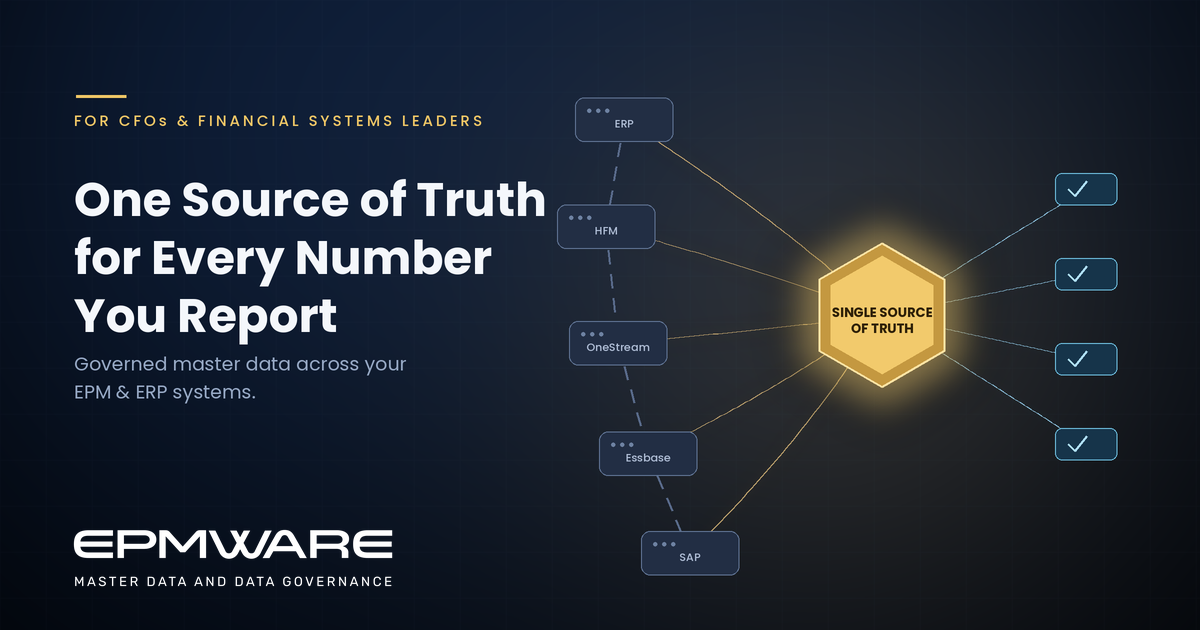
Centralized master data. Every account, entity, and hierarchy lives once, in a single governed source of truth—a golden record—that is then deployed automatically to every subscribing system. One definition. One vocabulary. One change, pushed everywhere it needs to go.
For a modern finance organization, the centralized model isn't just tidier. It's the difference between master data you can trust and master data you have to double-check.
How Does Master Data Management Speed Up the Financial Close?
Master data management speeds up the close by keeping account structures and hierarchies aligned across every system before close begins. Consolidation loads stop failing on out-of-sync members, teams skip days of structural reconciliation, and validation catches errors up front—so finance spends the close explaining results instead of chasing them.
What Centralizing Actually Buys You
Moving to a governed, centralized model changes the economics of financial data management in ways executives feel directly:
- Trustworthy reporting. A single, consistent record across every system means your consolidations and reports foot the first time—not the third.
- A faster, calmer close. When structures are already aligned, close stops being an exercise in structural reconciliation and starts being an exercise in analysis.
- Audit and compliance readiness. Every change carries a record of who requested it, who approved it, and when it deployed—so SOX evidence is a byproduct of the process, not a fire drill at year-end.
- Freedom from IT bottlenecks. Business users can own the metadata they understand best, instead of queuing behind an already-stretched IT team.
- Lower total cost. One governed process replaces the staffing, rework, and error-correction that fragmented, manual maintenance demands.
"But Isn't a Single Source a Single Point of Failure?"
It's a fair question, and it's the objection that kept many finance teams on the sidelines for years. The old worry was that centralizing everything created one repository that, if it went down, took the whole enterprise with it.
Modern financial master data management resolves this with a hub-and-spoke design. The central hub is where master data is authored, governed, and validated—but each subscribing system still holds its own operational copy of the metadata it needs to run. The hub isn't a live dependency sitting in the middle of every transaction; it's the governed source that keeps every system's copy correct and in sync. You get the control of centralization without turning your close into a single point of failure.
The real point of failure was never the central hub. It was the dozens of uncontrolled, manually maintained copies you have today.
What Good Looks Like
The organizations that have solved this share a common profile. Their financial master data is:
- Governed by workflow, so every change is requested, enriched, reviewed, and approved before it goes anywhere.
- Validated in real time, so duplicate members, broken hierarchies, and invalid changes are caught before they ever reach a target system—not discovered during close.
- Owned by the business, so the people who understand the chart of accounts don't have to file a ticket to change it.
- Deployed automatically from one hub to every subscribing EPM, ERP, and reporting system, so structures never drift apart again.
This Is Exactly What EPMware Was Built For
EPMware is a master data management and data governance platform built specifically for finance—by people who spent decades implementing the very systems you run.
Where generic MDM tools require heavy IT ownership and custom code, EPMware puts control in the hands of finance. Business users manage hierarchies, entities, and metadata through an intuitive, no-code interface, while a configurable workflow engine routes every change for the right reviews and approvals and validates it in real time before deployment. Master data is authored once in a centralized hub—your golden record—then pushed automatically to every upstream and downstream system that subscribes to it.
Out-of-the-box, plug-and-play adapters connect to the platforms finance actually runs on—OneStream, Oracle EPM (Cloud and on-premise), Hyperion (HFM, Essbase, Planning), SAP, Workday, NetSuite, Oracle EBS and Fusion, and more—with universal adapters for everything else. Every change is captured with a full audit trail, so governance and compliance stop being an afterthought. And because EPMware runs on the same code base in the cloud and on-premise, it fits wherever your systems live today and wherever they're headed next.
The result is what finance leaders at organizations like Trane Technologies and Honda have already put in place: master data they own, trust, and can defend—without the flat files, the macros, or the 11 p.m. reload.
See What This Looks Like for You
Every finance organization's master data footprint is a little different—a different mix of systems, a different close calendar, a different set of manual workarounds that have quietly become load-bearing.
The fastest way to see whether centralized, governed master data would move the needle for you is a short conversation. In a 30-minute discovery call, we'll map how metadata flows across your current systems, pinpoint where it's breaking down, and show you—against your own architecture—what a single, governed source of truth would change.
Schedule your discovery call with EPMware. Bring your hardest close-week story. We'll show you the version where it doesn't happen.
Share this article


